Through time
How much did a wedding cost in 1950, and who paid?
Nobody measured 1950 directly. The nearest count is a 1939 study of 154 Depression-era couples: an average of $392.30, about a quarter of annual household income, and only 70 percent held a reception. That is roughly $9,100 in 2025 dollars. Emily Post’s 1922 rule was that the bride’s parents paid for everything. Today’s widely quoted $34,000 is a mean from a self-selected survey; the median runs about a third lower.
Every planning conversation eventually arrives at the number, and the number is usually wrong in two directions at once: too high for what most people spend, and too vague about what your grandparents spent. Here is what can actually be sourced.
.jpg)
1939: the first count
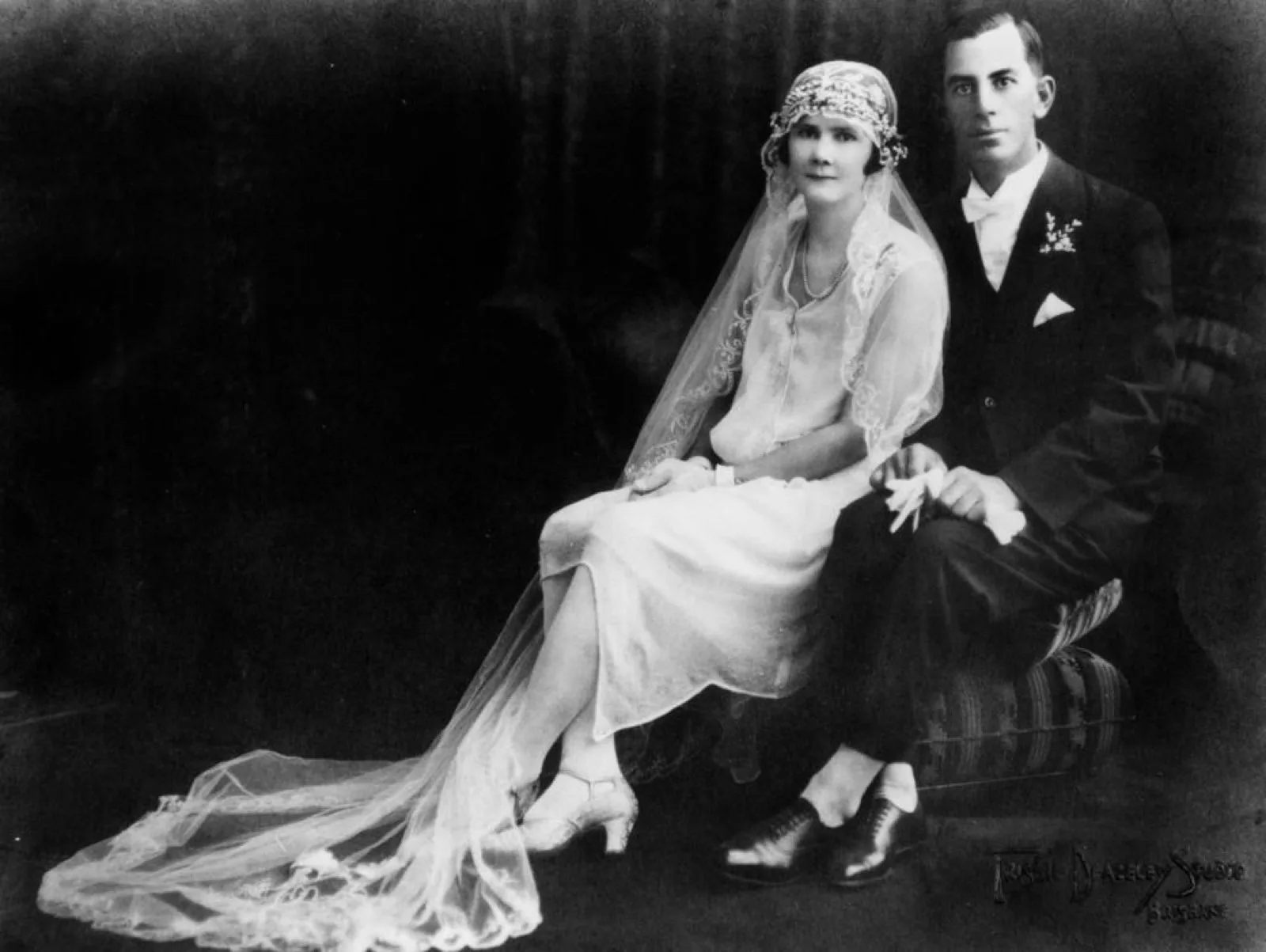
In April 1939 a University of Illinois sociologist named B. F. Timmons published "The Cost of Weddings" in the American Sociological Review.1 His sample was 154 couples married between 1934 and 1939, mostly the friends and relatives of his students, and he admitted it was small but "fairly good approximations of wedding expenditures."2 The average: $392.30, against an average household income of $1,569.20, so about a quarter of a year's income.23 Only 70 percent of his couples held a reception at all.2
There is no equivalent study for 1950. The first major bridal-market survey came in the late 1950s, when Bride's magazine queried 3,800 brides, and its purpose was to sell advertising: the historian Vicki Howard dates "today's wedding arms race" to exactly that decade.4 So for 1950 the honest move is arithmetic. Using the Bureau of Labor Statistics consumer price index, Timmons's $392.30 of 1939 is about $9,100 in 2025 dollars, and a dollar of 1950 is worth about thirteen of today's.5
The table
| Year | Figure | What it is | In 2025 dollars |
|---|---|---|---|
| 1934–39 | $392.30 | Average, 154 couples (Timmons 1939)2 | ≈ $9,1005 |
| 1934–39 | $1,569.20 | Average household income of those couples3 | ≈ $36,3005 |
| 2012 | $27,427 / $18,086 | Mean / median, The Knot survey6 | ≈ $37,800 / $24,9005 |
| 2024 | $33,000 | Mean, ~17,000 Knot members; $18,000 Utah to $57,000 New Jersey7 | ≈ $33,9005 |
| 2025 | $34,000 | Mean, 10,474 Knot members; $292 per guest, 117 guests8 | $34,000 |
Read the middle column carefully. The modern numbers are means from The Knot's own membership, and in 2015 Slate showed why that matters: in 2012 the mean was $27,427 while the median was $18,086, and The Knot then stopped publishing the median.6 Ninety-nine couples at $10,000 and one at a million gives an "average" near $20,000. The number your parents heard on the news is the mean.
Who paid, and why
Emily Post, 1922: "All the expenses of a wedding belong to the bride's parents; the invitations are issued by them, the reception is at their house, and the groom's family are little more than ordinary guests."9 The groom's list was short: the engagement ring "as handsome as he can possibly afford," a wedding present, his bachelor dinner, the license, and gifts for his best man and ushers.9 Post's "biggest item of expense" was the trousseau, and she was firm that "it is unthinkable for the bride to defray the least fraction of the cost of the wedding journey, no matter though she have millions in her own right, and he be earning ten dollars a week."910 That is etiquette, not economics. The economics run the other way in most of the world: payments at marriage "have existed throughout the history of most developed countries," and dowry, the bride's side paying, is the arrangement of capital-rich societies, while bride price is the more common system where labor matters more than land.1112 The Emily Post Institute today calls the old division "variable" and says costs are shared.13
Why your mother cares
If your grandmother married in the fifties, Post's rule was unchanged from 1922, and her parents paid. If your mother married in the eighties or nineties, she heard the first "average wedding cost" headlines, which were means, and she absorbed a number that was probably a third higher than what most of her friends spent. When she worries about the budget, she is comparing your plans against a figure that was designed to sell magazine pages. Show her the median. Then show her Timmons: a quarter of a year's income, and three in ten skipped the party.
In 1939 a professor asked 154 couples what they spent and published it in a journal. That is the whole data set for a decade. The rest is inflation math.
Asked at the desk
How much did a wedding cost in the 1930s and 1940s?
A 1939 study of 154 couples found an average of $392.30, about a quarter of annual household income; roughly $9,100 in 2025 dollars.25
Is the $34,000 average wedding cost accurate?
It is a mean from a self-selected survey of one company’s members. In 2012 the median was about a third lower than the mean, and the median is no longer published.68
The receipt
- B. F. Timmons, "The Cost of Weddings," American Sociological Review 4:2 (April 1939), p. 224. doi.org
- Jenni Avins, "The venerable, 80-year tradition of the insanely expensive American wedding," Quartz, 2 July 2014. qz.com
- Lucia Peters, "Have Weddings Always Been This Expensive?", Bustle, 2 July 2014. bustle.com
- Vicki Howard, "How Bride’s Magazine created today’s wedding arms race," Bangor Daily News, 10 June 2013. bangordailynews.com · Vicki Howard, Brides, Inc. (University of Pennsylvania Press, 2006). pennpress.org
- Federal Reserve Bank of Minneapolis, "Consumer Price Index, 1913–" (Bureau of Labor Statistics CPI-U annual averages: 1939 = 13.9, 1950 = 24.1, 2012 = 229.6, 2024 = 313.7, 2025 = 321.9). Conversions are our arithmetic from that table. minneapolisfed.org
- Will Oremus, "The Wedding Industry’s Pricey Little Secret," Slate, 19 March 2015. slate.com
- The Knot Worldwide, "Weddings Shine Bright in 2025," press release, 27 February 2025 (The Knot 2025 Real Weddings Study). theknotww.com
- The Knot Worldwide, "The Knot Worldwide Unveils 2026 Real Weddings Study," press release, 18 February 2026. theknotww.com
- Emily Post, Etiquette (1922), chapter XXII, "The Day of the Wedding," Bartleby. bartleby.com
- Emily Post, Etiquette (1922), chapter XXI, Bartleby. bartleby.com
- Siwan Anderson, "The Economics of Dowry and Brideprice," Journal of Economic Perspectives 21:4 (2007). aeaweb.org
- Wikipedia, "Dowry" and "Bride price." Dowry · Bride price
- Emily Post Institute, "Wedding Expenses: The Traditional Division." emilypost.com
Shelved 2026-09-05 · back to the wall