The rebranded ones
Why do we have bridesmaids, and why do they dress alike?
Roman law required ten witnesses, but only for the patrician rite of confarreatio, and said nothing about dress or spirits. The matched bridal party as we know it starts with Queen Victoria, who sketched the white dresses for her twelve bridesmaids in 1840. Colored matching gowns were standard by the 1950s. The claim that bridesmaids dressed alike to confuse evil spirits circulates without a historical source.
The internet's answer is that ancient Roman bridesmaids dressed exactly like the bride to confuse evil spirits or jealous suitors. Trace that sentence back and it lands on a CNN listicle, a Cosmopolitan piece and a popular author, never on a Roman.1 The Romans left us their marriage law, and it says something more interesting.


Ten witnesses, for one kind of wedding
The jurist Gaius, writing in the second century, describes confarreatio, the old religious marriage of the patrician class: a sacrifice to Jupiter, "a cake of spelt," a set form of words, "in the presence of ten witnesses."2 That is the origin of the "ten bridesmaids" claim, and it is not about maids. The other Roman forms needed fewer: coemptio, a mock sale, wanted "at least five witnesses, citizens of Rome above the age of puberty, besides a balance holder."2 Witnesses, men, holding a scale. Not a bridal party in matching stolas.
The Bible gets pulled in too, because Laban gave each of his daughters a maidservant at her wedding: Zilpah to Leah, Bilhah to Rachel.3 They were servants, and Genesis gives them no role in the ceremony.
10 February 1840: twelve dresses, one sketch
The matched bridal party has a birthday. Queen Victoria, twenty years old, designed her bridesmaids' dresses herself: a white dress "trimmed with sprays of roses on the bodice and skirt," with "a matching spray of roses" in the hair, according to the Royal Collection's record of her sketch.4 The twelve were the eldest daughters of peers, and twelve attendants carried her train down the aisle.45 White was the point. It was, in the words of the V&A's wedding-dress curator Edwina Ehrman, "a very, very expensive color, and most people couldn't afford to have a white dress in their wardrobe, so it was a special color, a prestigious color."6 Twelve girls in white was a statement about the household paying for them.
Then color, and a bill
When exactly the matched colored dress replaced white is not documented in any museum or history opened for this shelf; what a museum does hold is the result. Aberdeen's collection has a green satin and chiffon bridesmaid's dress made locally around 1956, one of a set.7 By your grandmother's decade the pattern was fixed: a color, a fabric, a matched row.
The cost landed on the maids. The Knot's survey of nearly seventeen thousand couples married in 2024 put the average bridesmaid dress at $128, unchanged since 2021, and the all-in cost of being a bridesmaid at around $1,900 once travel, gifts and parties are counted.89 A 2016 survey of dress shoppers got $1,324.10 Emily Post saw this coming in 1922 and did not like it: every article worn by the bridesmaids "must be paid for by the wearers," and "many a young girl has had to refuse the joy of being in the wedding party because a complete bridesmaid outfit costs a sum that parents of moderate means are quite unable to meet."11
Why your mother cares
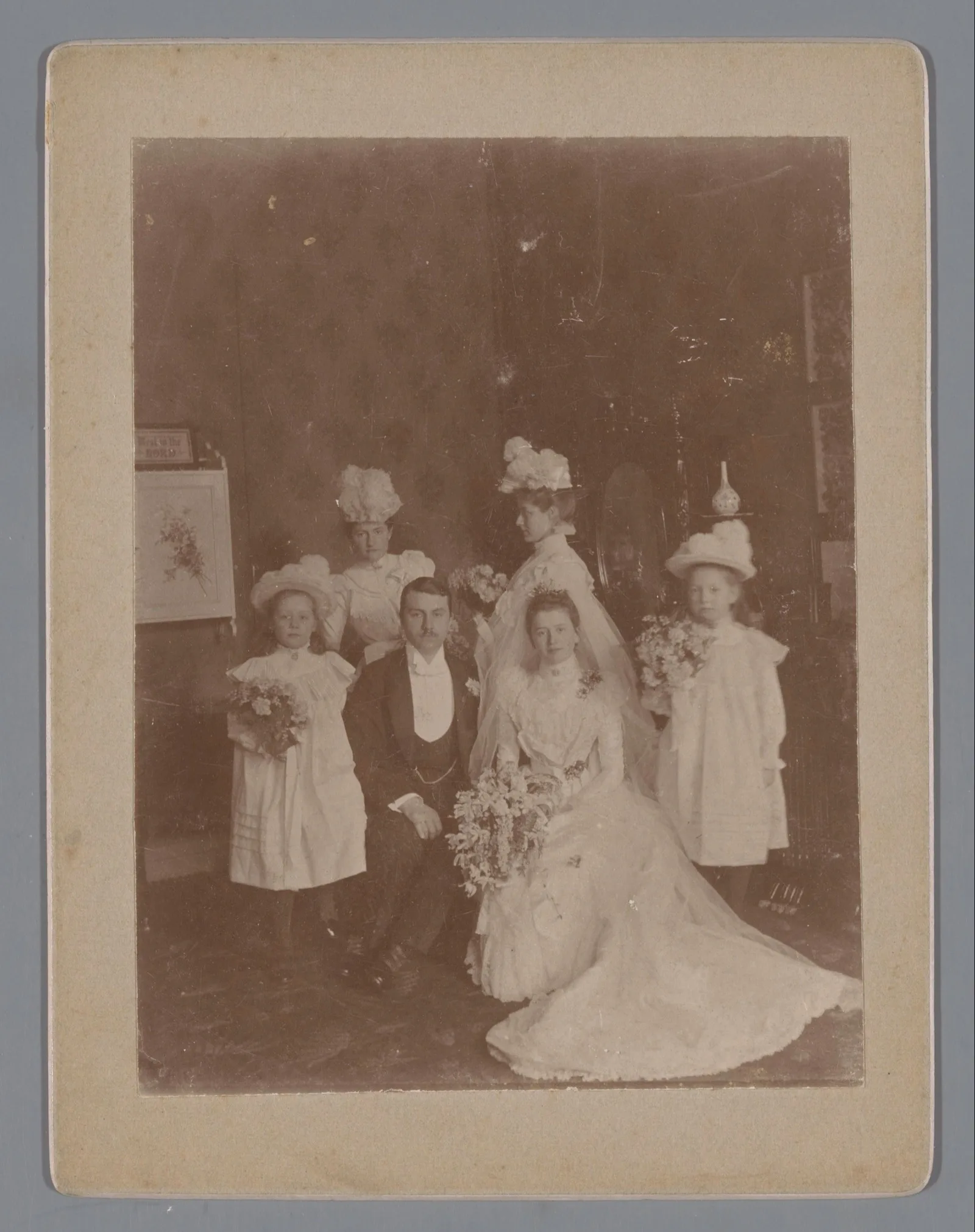
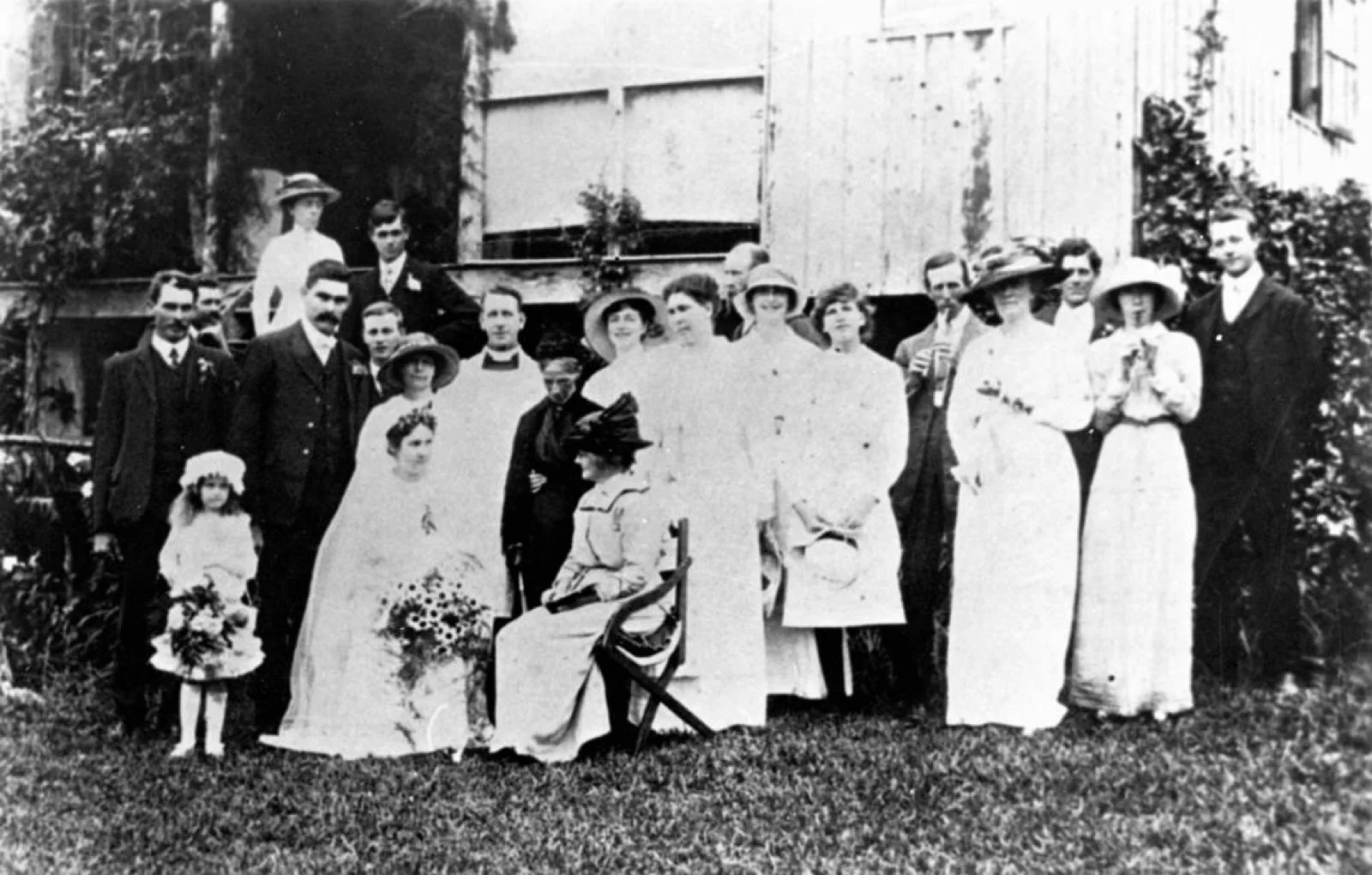
Your mother's bridesmaids were her sisters and her best friends in a color she chose, in a photograph she still has. What she remembers is not the dress. It is who stood there. The Roman witnesses were there to say the marriage happened; that is still the whole job. Everything else, the sketch, the color, the $128, is upholstery.
Victoria's bridesmaids exist in a queen's pencil sketch and a painting. Nobody photographed the row. It was still a row.
Asked at the desk
Did Roman bridesmaids dress like the bride to confuse evil spirits?
No Roman source says so. Roman law required ten witnesses for the patrician confarreatio rite and five for coemptio; it says nothing about dress.2
When did matching bridesmaid dresses start?
Queen Victoria sketched matching white dresses for her twelve bridesmaids in 1840. Matched colored sets were standard by the 1950s; a museum in Aberdeen holds one from about 1956.47
How much does it cost to be a bridesmaid?
The dress averaged $128 in 2024; the full cost of being in the party is estimated at around $1,900 once travel, gifts and events are counted.89
Who pays for bridesmaid dresses?
By long custom, the bridesmaids. Emily Post said so in 1922 and warned that it priced some friends out of the party.11
The receipt
- Reader’s Digest, "The History of Bridesmaids," and Mental Floss, "The Seriously Dark Origins Behind Matching Bridesmaid Dresses," which trace the evil-spirits claim to popular sources rather than to any Roman text. rd.com · mentalfloss.com
- Gaius, Institutes I.112–113, trans. E. Poste, Roman Law Library, Université Grenoble Alpes. droitromain.univ-grenoble-alpes.fr
- Genesis 29:24, 29 (NRSVUE), Bible Gateway. biblegateway.com
- Royal Collection Trust, "Design for Queen Victoria’s bridesmaids’ dresses," c. 1840, RCIN 980021.o. rct.uk
- Summer Lee, "1840 – Queen Victoria’s Wedding Dress," Fashion History Timeline, Fashion Institute of Technology. fashionhistory.fitnyc.edu
- Mental Floss, quoting Edwina Ehrman, curator, Victoria and Albert Museum. mentalfloss.com
- Aberdeen Archives, Gallery & Museums, "1950’s Green Bridesmaids Dress," c. 1956, ABDMS023759. emuseum.aberdeencity.gov.uk
- The Knot, "The Average Bridesmaid Dress Cost," from The Knot 2025 Real Weddings Study. theknot.com
- SoFi, "The Cost of Being in a Wedding," tallying The Knot 2025 figures. sofi.com
- Priceonomics, "How Much Does It Cost to Be a Bridesmaid?" (2016). priceonomics.com
- Emily Post, Etiquette (1922), chapter XXI, Bartleby. bartleby.com
Shelved 2026-09-05 · back to the wall