Around the world
What is the Chinese wedding tea ceremony, and what does the double happiness character mean?
The couple kneels and serves tea to parents and elders, groom’s side first, and receives red envelopes or gold in return. Tea has stood for marriage since at least 1597, when a Ming tea writer explained that a tea plant cannot be transplanted. The double happiness character is different: the Wang Anshi legend has no source, and the oldest datable examples are porcelain from the early 1800s.
Two rituals share this page because they share a table. At a Chinese wedding the couple kneels on cushions and offers tea with both hands to the groom's parents, then his grandparents and elders, then the bride's side, and each elder hands back a red envelope or a piece of gold. Behind them, on the wall, the door, the envelopes and the cake, is 囍, two "joy" characters welded into one. One of these has a paper trail back to the Ming. The other has a legend.


Why tea
Xu Cishu, a Ming connoisseur, finished his Cha Shu, "Treatise on Tea," in 1597. In a section on origins he wrote: "Tea does not move its root; plant it, and it must grow from seed. The ancients, when marrying, always used tea as the gift, taking the meaning that it cannot be transplanted and that it bears seed. People today still call the rite 'sending down the tea.'"1 That is the whole theory in three sentences, from a man who wrote a whole book about the plant: a tea bush dies if you move it, so it stood for a wife who would not be moved, and it seeds, so it stood for children. His "ancients" is vague. His own date is not. By 1597 the betrothal tea was old enough that a tea expert had to explain it.
The betrothal gift itself is older than tea's part in it. The Han-era Yili prescribes a goose for the first approach to a bride's family.2 By the Ming the goose had become tea in China, and only Korea kept the bird, which is a story for the next book on this shelf.
What a missionary saw in 1865
The kneeling ceremony as couples do it today is not in Xu Cishu. The earliest full description we could open is from Justus Doolittle, an American missionary in Fuzhou who published Social Life of the Chinese in 1865. On the morning after the wedding the couple faced the groom's grandparents, seated in two chairs with their backs to the ancestral table, and "kneel down three or four times before them, bowing their heads toward the ground, as in worshiping the tablets."3 Then the parents took the chairs and it was repeated, then the uncles and aunts "in the order of their rank."3 The gift ran the way it still runs: "While the bride is on her knees her new mother usually arranges some costly ornaments in her hair, as gold or pearls, or gives her some valuable finger-rings."3 And the tea: "The women who assist the bride in performing these ceremonies improve the opportunity to offer tea to her parents at this period, and are rewarded for their attentions with a present of money on the spot."3 Attendants poured in 1865; the couple pours now. Everything else, the chairs, the order of seniority, the gold, the money, is in place.
Tea ran the other way too. When the groom paid his first visit to the bride's family he was "treated successively to three cups of tea and three pipes of tobacco" before being allowed to see his mother-in-law.3
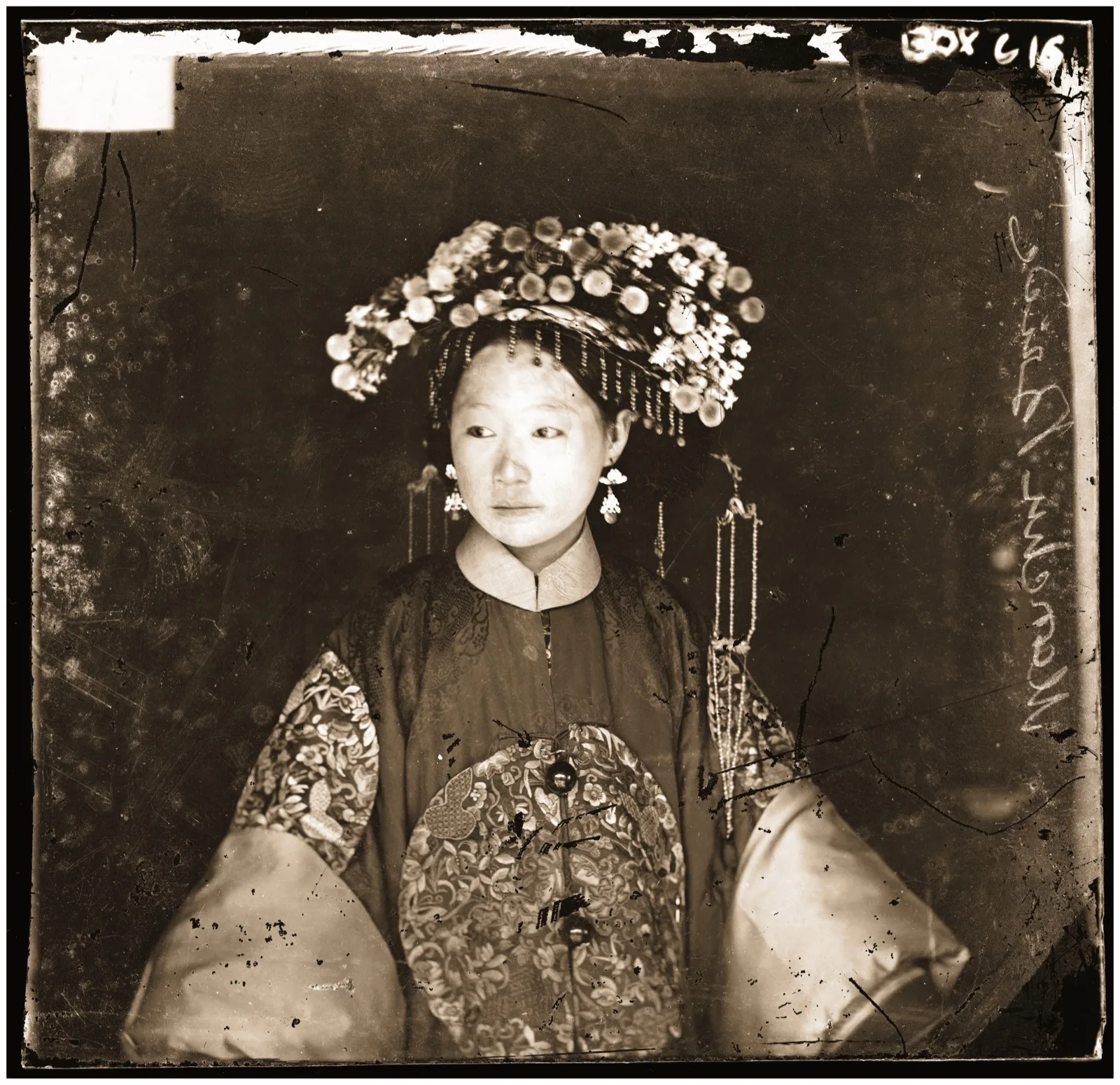
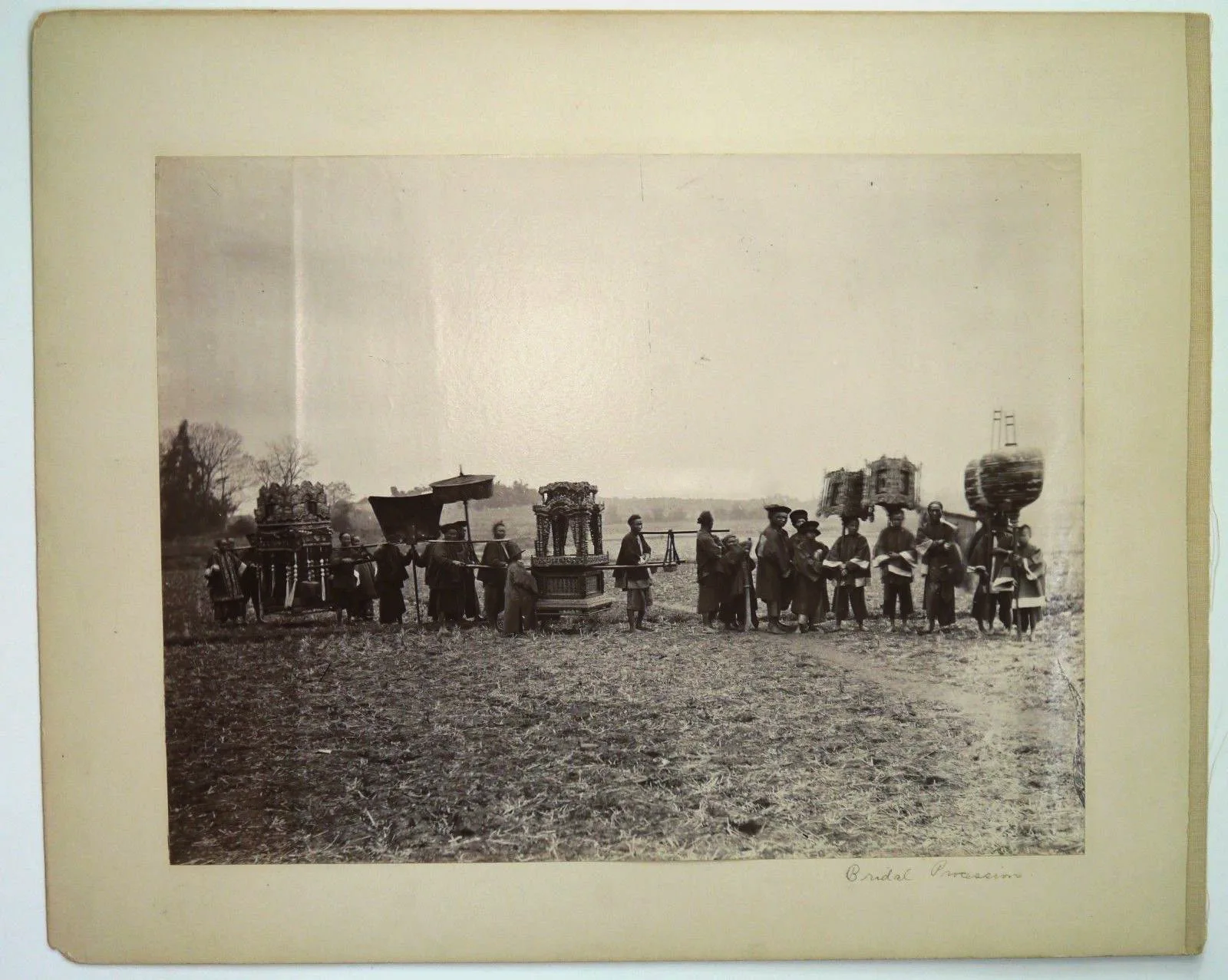
John Thomson photographed a Manchu bride in Peking in 1871, the plate below, and wrote down the Manchu version for his book. A month before the wedding the groom's family sent "four pigs, four sheep, four geese, and four jars of wine"; the invitations went out "printed on sheets of red paper about a foot long"; "The bride's sedan is covered with crimson cloth. Her veil is also crimson."4 The geese had not quite gone. Thomson also saw the bride's prospects darkly: a girl "entirely subjected to her new parent's rule," and it was "always deemed fortunate by the girl's friends if the mother of the bridegroom be already dead."4 The Wellcome Collection, which holds his glass negative, reads that view in her face.5 The tea ceremony was a daughter-in-law's first act of service. Its survival as a warm family moment is a real change in what it means.
How it runs now
The Chinese Historical and Cultural Project, a San Jose community museum, gives the order: the newlyweds serve "holding the teacups with both hands," beginning with the groom's parents and going from oldest to youngest, the elders seated and the couple kneeling, the bride before her father-in-law and the groom before his mother.6 The tea carries lotus seeds and two red dates, whose names pun on "child" and "early."6 In return come lai see, red envelopes "stuffed with money or jewelry."6
Kaitlin Leung of the Leung family, who wrote up her sister's 2021 ceremony, says the groom's side still usually goes first "but there is no strict rule these days," since the old order reflected the bride being absorbed into the man's family.7 The phrase is simple: the relative's name, then "please have some tea." Budget one to two hours for a big family; theirs took forty-five minutes, and the 102-year-old great-grandmother "was very happy with all the wedding activities."7
The character
囍 is shuangxi, "double joy." The story told about it, in China Daily and on a thousand wedding sites, is that the Song statesman Wang Anshi passed the imperial examination and got married in the same week and wrote the two characters as one.8 China Daily calls it "one folk story."8 We could not find it in any text older than the twentieth century, and neither, as far as we can tell, has anyone who repeats it. This page treats it as folklore until someone produces the page they came from.
What can be dated is porcelain. The Metropolitan Museum holds a Jingdezhen vase from the Daoguang reign (1820–50) painted with bats, peaches and the double happiness character.9 The Swedish ceramics scholar Jan-Erik Nilsson puts the motif on porcelain "from at least the early 19th century" and dates its explosion to the wedding of the Tongzhi emperor in 1872, the first imperial wedding in two hundred years, for which one order alone shipped 7,294 pieces to Peking in 120 barrels, many with the character.10 Tsinghua University's art museum, which holds a red plate from the set, records that production began in 1868 and that by the first month of 1872 the kilns had finished 10,072 pieces for the wedding.11 A nineteenth-century imperial wedding is the moment the character became the wedding character. That is a good origin story. It just is not the one on the invitation.
Why your mother cares
Because the tea is the part of the day where she is served. Every other ritual puts the couple at the centre; this one puts the couple on their knees in front of her, by name, with both hands. The Ming writer said the bush cannot be moved. Your mother hears that as a promise about the family, and the red envelope is her answer. Do not skip her side to save ten minutes.
In 1597 a man who grew tea explained a wedding gift by pointing at the plant: move it and it dies. Four centuries later the explanation still fits on one cup.
Asked at the desk
What is the order of a Chinese wedding tea ceremony?
Traditionally the groom’s parents first, then his grandparents and elders from oldest to youngest, then the bride’s side. Many couples now serve both families in any order they like.67
Why is tea used at a Chinese wedding?
A Ming tea treatise of 1597 explains that a tea plant cannot be transplanted and grows only from seed, so tea stood for a wife who would not leave and for children to come. Betrothal gifts were already called "sending down the tea."1
What do the elders give back?
Red envelopes of money, called lai see or hongbao, or gold jewellery for the bride. A missionary in 1865 saw the groom’s mother put gold and pearls in the kneeling bride’s hair.36
What does the double happiness symbol mean?
囍 is two "joy" characters joined, used for weddings. The popular story credits the Song statesman Wang Anshi, but no source older than modern retellings has been found. The oldest datable examples are on porcelain from the 1820s to 1850s.89
How long does the tea ceremony take?
One to two hours for a large family; a smaller one can be done in forty-five minutes.7
The receipt
- Xu Cishu (許次紓), Cha Shu (茶疏), Ming, 1597 (preface dated 1607), section 考本, Chinese Wikisource. Our translation. zh.wikisource.org
- Yili (儀禮), "Shi hun li" (士昏禮), Chinese Text Project. ctext.org
- Justus Doolittle, Social Life of the Chinese, vol. 1 (New York: Harper, 1865), ch. III "Betrothal and Marriage, continued," pp. 93–96, Internet Archive. archive.org
- John Thomson, Illustrations of China and Its People, vol. 4 (London, 1873–74), plate XIII, "Manchu Bride and Maid," Wikisource. en.wikisource.org
- Wellcome Collection, "China: a Manchu bride. Photograph by John Thomson, 1871," reference 19684i, CC BY 4.0. wellcomecollection.org
- Chinese Historical and Cultural Project (San Jose, California), "Chinese Wedding Tea Ceremony," virtual museum Q&A. chcp.org
- Kaitlin Leung, "How to Do a Chinese Wedding Tea Ceremony," The Woks of Life, updated 7 June 2022. thewoksoflife.com
- Lao Huang and Xiao Chu, "The symbol for happiness," China Daily, 19 April 2013. chinadaily.com.cn
- The Metropolitan Museum of Art, "Vase decorated with bats and peaches amid scrolling floral vines and ‘double happiness’ character," Jingdezhen ware, Qing dynasty, Daoguang period (1820–50), collection record. metmuseum.org
- Jan-Erik Nilsson, "Double happiness, wedded bliss, shuangxi," Gotheborg.com glossary of Chinese porcelain. gotheborg.com
- Tsinghua University Art Museum, "Red Glazed Plate with Golden ‘Xi’," Tongzhi period, Qing dynasty, collection record. artmuseum.tsinghua.edu.cn
Shelved 2026-09-05 · back to the wall