Around the world
What is a pyebaek, and why is there a wooden goose at a Korean wedding?
The pyebaek is the bride’s first formal greeting to the groom’s parents: deep bows, then dates and chestnuts tossed into her skirt for children. The goose is older. Chinese ritual texts of the Han period had the groom bring a live goose, Korea kept the rite under Zhu Xi’s Family Rituals, and carved a wooden one when live birds ran short. Geese, the story goes, mate for life.
At a Korean-American wedding the pyebaek usually happens during the cocktail hour. The couple changes into hanbok, bows to the groom's parents, then the bride's, and the parents throw dates and chestnuts that the couple tries to catch in a cloth. Somewhere near the table sits a pair of carved wooden ducks. Guests are told the ducks are geese and that geese mate for life. Both things are true, and the goose has the longer paper trail of anything on this shelf.
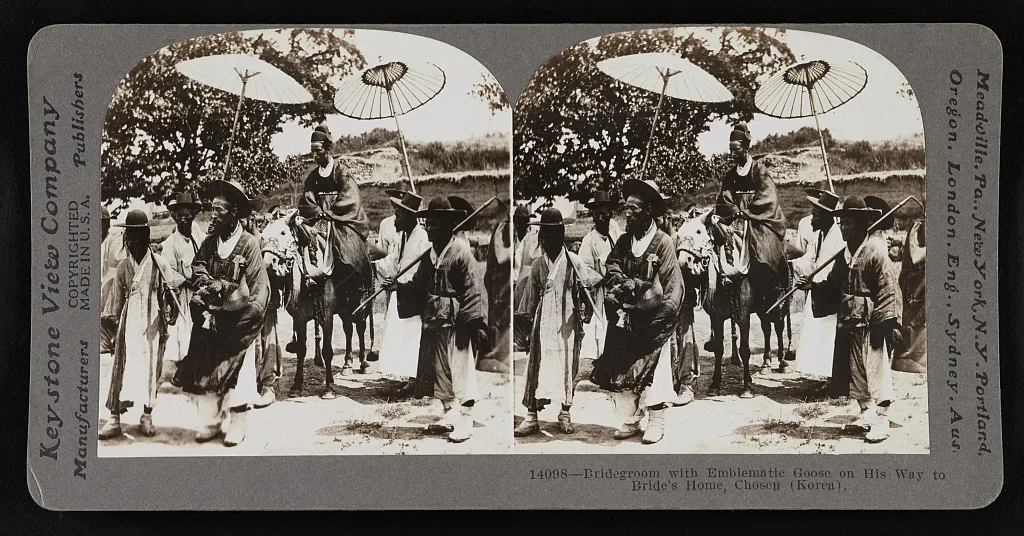
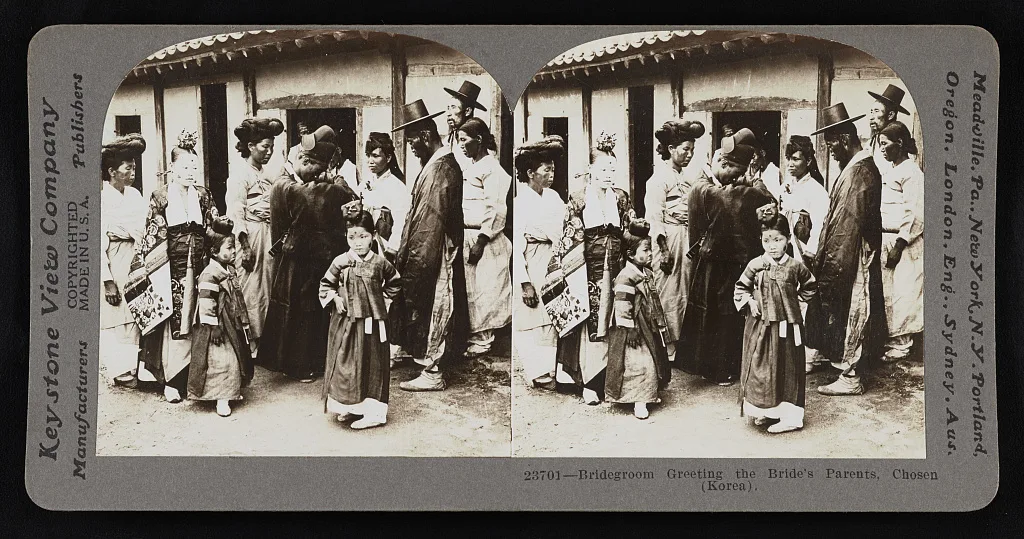
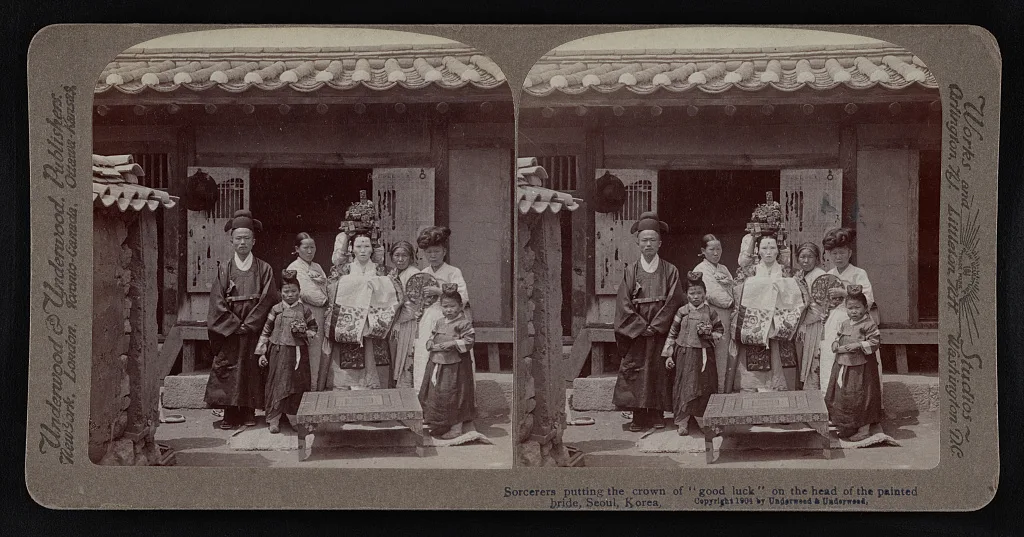
A goose in the Han dynasty
The Yili, the Confucian "Etiquette and Rites," survived into the early Han period (206 BCE to 220 CE) as seventeen chapters, the second of them "The marriage of an ordinary officer."2 It lays out six steps, and a goose keeps turning up. For the first, the presenting of the betrothal gift: 納采,用雁, "the betrothal gift: use a goose."1 For announcing the good omen: 納吉用雁, "use a goose, as in the betrothal rite."1 For asking the date: 請期,用雁.1 The bird was the groom's family's calling card at the bride's door.
A thousand years later the Neo-Confucian master Zhu Xi (1130–1200) compressed the classics into a household handbook, the Family Rituals, with a chapter on weddings.3 That book, not the Yili itself, is what crossed to Korea. The Encyclopedia of Korean Culture, written by Seoul National University's Lee Kwang-gyu, dates the arrival to the end of Goryeo, with the upper class adopting it first and commoners only in late Joseon.4 Korean scholars then wrote their own manuals on it, the best known being Yi Jae's Sarye pyeollam.6
The Victoria and Albert Museum, which holds a lacquered wooden goose from the 1800s, puts the twist in one sentence: "The presentation of a live goose was initially borrowed from Chinese Confucian wedding rituals and the custom survived in Korea long after it had disappeared in China."7 Real geese "were substituted with wooden geese and ducks (in Korean, 'kirogi'), supposedly because it was so difficult to obtain the former."7 The Korean encyclopedia notes, drily, that the carving is shaped like a duck despite the name.5
What the goose did
The rite is the jeonanrye, "presenting the goose." The groom rode to the bride's house with an attendant called the goose-bearer walking ahead; at the house he set the bird on a table and bowed twice.5 The meaning, in the encyclopedia's words, was "a vow to Heaven to become husband and wife," because Koreans believed a goose takes one mate and dies if it loses it.5
Two foreigners watched it in the 1880s and 1890s. William Elliot Griffis in 1882: "The prominent symbolic figure at the wedding is a goose, which, in Corean eyes, is the emblem of conjugal fidelity. Sometimes this mok-an is of gilded wood, sometimes it is made out of a fish for eating, again it is a live bird brought in a cloth with the head visible."8 Isabella Bird, in 1898, saw the procession: the groom "on horseback, and in Court dress," preceded by a man with a white umbrella and another "dressed in red cloth" carrying "a goose, which is the emblem of conjugal fidelity." At the house "he takes the goose from the hands of the man in red, goes into the house, and lays it upon a table."9 Then the part Bird thought mattered: the bride bows twice, he bows four times, and "it is this public reciprocal 'salutation' which alone constitutes a valid marriage."9 A cup of wine went from him to her.
Bird also wrote down the line most wedding blogs leave out: "conjugal fidelity is only required from the wife, and is a feminine virtue only."9 The goose faced one way. Couples who keep the ducks today face them at each other, and that is a real change, not a return.
Then the pyebaek
The pyebaek came after. In the encyclopedia's definition it is the rite in which the bride, arriving at her husband's family home, pays her respects to his parents and the elders of the house.6 She brought the food herself: jujubes, chestnuts, liquor, side dishes, fruit.6 After the bows, "the parents-in-law toss dates onto the bride's skirt" and charge her to be rich, honoured and the mother of many sons.6 Traditionally this happened on the third day, when the bride made the move to her husband's house; modern couples do it the same day, at the venue or church.6
The dates-for-boys, chestnuts-for-girls reading that American couples are given comes from practitioners rather than the old texts. LeeHwa Wedding, a Los Angeles hanbok house founded in 1993, tells its clients the caught dates and chestnuts foretell "how many girls (chestnuts) and boys (dates) they would bear," and adds the piggyback: the groom carries the bride around the table, then his mother-in-law, then his own mother.11 The Joseon source says sons. The Los Angeles version splits the difference, and nobody has to know which chestnut was which.
In Korea now
Korea's official cultural site described the rite this summer: after the ceremony the couple change into hanbok for pyebaek, and "the custom of parents throwing jujubes and chestnuts to symbolize children onto the bride's skirt is still seen at weddings in Korea. But pyebaek is now an option based on the values of the bride and groom."10 Church weddings arrived in the 1890s; in the 1970s and 1980s companies married their employees in gymnasiums, dozens of couples at a time, with electric rice cookers as the gift.410 The goose and the skirt outlasted all of it.
Why your mother cares
Because the pyebaek is the one part of the day that is explicitly about her. It began as the bride's first formal act toward her husband's mother, and the food on the table was chosen for that woman. If your mother-in-law asks for it, she is asking to be greeted, in front of people, by the person joining her family. Twenty minutes and a bag of chestnuts is a small price for that sentence to be said out loud.
In 1898 a woman travelling alone through Korea wrote down a groom taking a goose from a man in red and laying it on a table. She thought the bows were the wedding. She was right.
Asked at the desk
What happens at a pyebaek?
The couple, in hanbok, bows deeply to the groom’s parents and then the bride’s. The parents toss dates and chestnuts for the couple to catch in a cloth, for children, and the groom carries the bride, and often both mothers, around the table.611
What do the wooden ducks at a Korean wedding mean?
They stand in for the live goose a groom once presented at the bride’s house as a pledge of fidelity, because geese were believed to take one mate for life. Carved birds replaced live ones when geese were hard to get.57
Why dates and chestnuts?
The Joseon-era sources say the in-laws threw dates onto the bride’s skirt while wishing her wealth, rank and many sons. The boys-and-girls split is a modern gloss.611
Is the pyebaek still done in Korea?
Yes, as an option. Korea’s cultural ministry site noted in 2026 that the tossing is "still seen at weddings in Korea" but that the rite is now the couple’s choice.10
The receipt
- Yili (儀禮), "Shi hun li" (士昏禮, The marriage of an ordinary officer), Chinese Text Project. ctext.org
- Ulrich Theobald, "Yili 儀禮 ‘Etiquette and Rites’," ChinaKnowledge.de, 2010. chinaknowledge.de
- Ulrich Theobald, "Zhuzi jiali 朱子家禮 ‘Master Zhu’s Family Rituals’," ChinaKnowledge.de, 2013. chinaknowledge.de
- Lee Kwang-gyu (이광규, Seoul National University), "혼례" (Wedding rites), Encyclopedia of Korean Culture, Academy of Korean Studies. encykorea.aks.ac.kr
- Lee Kwang-gyu, "목기러기" (Wooden goose), Encyclopedia of Korean Culture, Academy of Korean Studies. encykorea.aks.ac.kr
- Yeo Joong-chul (여중철, Yeungnam University), "폐백" (Pyebaek), Encyclopedia of Korean Culture, Academy of Korean Studies, 1995. encykorea.aks.ac.kr
- Victoria and Albert Museum, "Kirogi (Wedding Goose)," Korea, 1800–1900, O22626, collection record. collections.vam.ac.uk
- William Elliot Griffis, Corea, the Hermit Nation (New York, 1882), Internet Archive. archive.org
- Isabella L. Bird (Mrs Bishop), Korea and Her Neighbours (1898), the chapter on marriage, Project Gutenberg. gutenberg.org
- Hong Angie, "[K-matrimony] ② Evolution of wedding customs reflects era’s traits," Korea.net (Ministry of Culture, Sports and Tourism), 18 June 2026. korea.net
- LeeHwa Wedding & Hanbok (Los Angeles, founded 1993), "The Paebaek Tea Ceremony." leehwawedding.com
Shelved 2026-09-05 · back to the wall