Around the world
What is san-san-kudo, and why does a Japanese bride wear white?
San-san-kudo is three sips from each of three sake cups, nine in all, shared by the couple. Samurai etiquette books prescribed it long before cameras; an 1871 translation of one reads like a modern order of service. The shrine wedding around it is younger: the crown prince married before the kami in May 1900, and a Tokyo shrine began offering the rite to the public in 1901.
The three lacquered cups stack small to large. The groom sips three times from the first, the bride three times, and so on through the stack until nine sips have gone round. It is the quiet centre of a Japanese wedding, and it gets described online as an ancient Shinto rite. Half of that sentence is right. The cups are old. The shrine is not.

What the etiquette book says
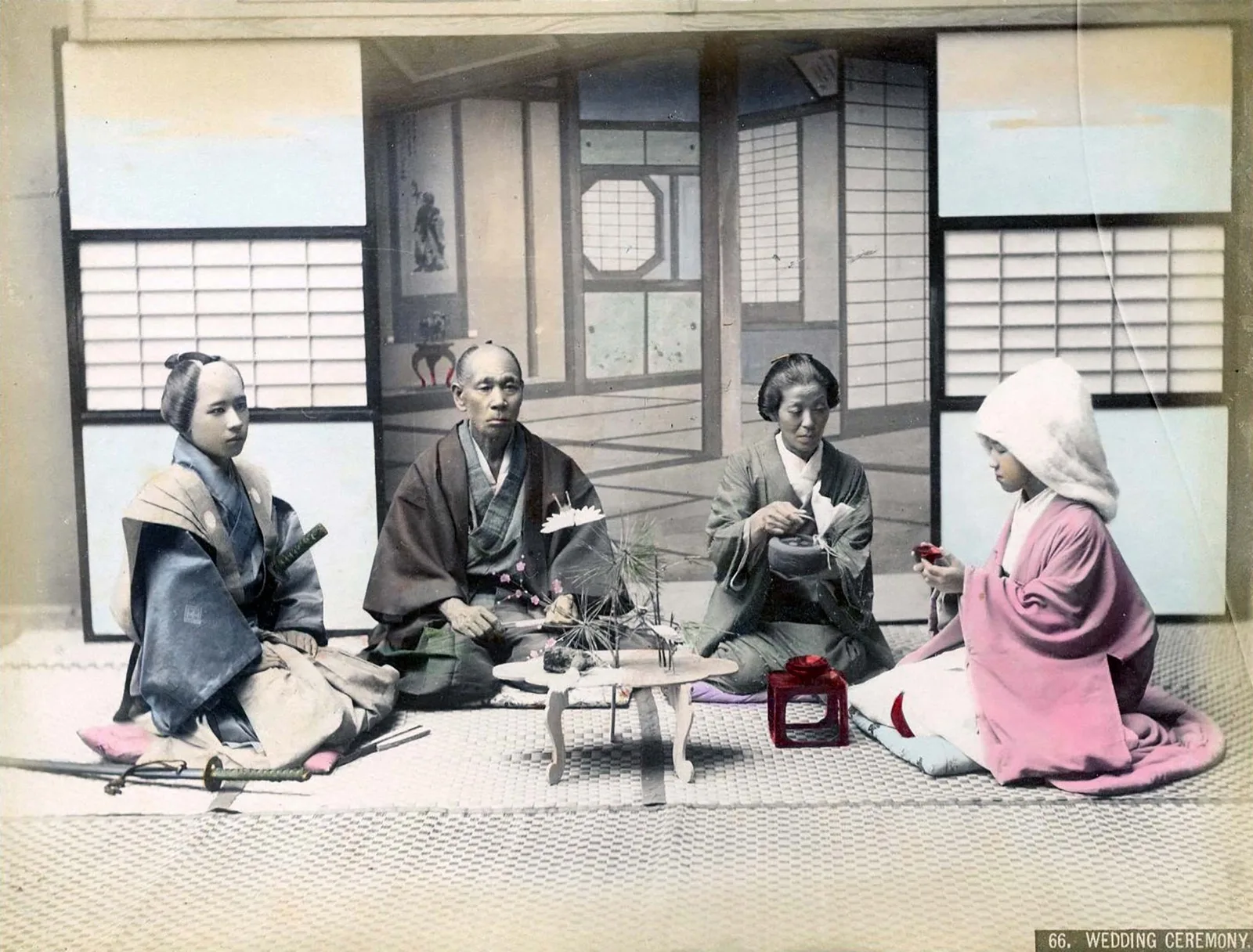
In 1871 the British diplomat A. B. Mitford translated a Japanese book of ceremonies, the Shōrei Hikki, as an appendix to Tales of Old Japan.1 It is a rulebook, class by class, and it is blunt: "There must be three wine-cups set out upon a tray. The ceremony of drinking wine three times is gone through."1 For a high-rank house it spells the whole thing out: the cups placed "one on the top of the other before the bridegroom, who drinks two cups from the upper cup," a third, then the cup carried to the bride, "who drinks three cups," and so through the second and third cup until the pile goes back to the raised floor.1 A footnote adds the detail every nervous groom wants: "Each cup contains but a sip."1
The book gives one meaning and it is not about the number nine. Two bottles, one with a male paper butterfly and one with a female, are poured into a single kettle: "The pouring together of the wine on the wedding night is symbolical of the union that is being contracted."1 Neither this text nor the next one explains three-times-three. What people say it means today, three for heaven, earth and humankind, or for the three couples in the room, is later commentary. The old book just counts.
The cups did not stop at the couple. The bride was then led to her parents-in-law, and a second round went through the father-in-law, the bride and the mother-in-law until "the parents-in-law and the bride thus have drunk in all nine times."1 The marriage was between houses, and the sake said so.
No priest, no shrine, a dinner party
Basil Hall Chamberlain, the British Japanologist, wrote the standard English handbook on the country in 1890. On weddings: "Religion has no say in the matter."2 The ceremony happened "immediately on the bride's arrival at the house of her husband's parents" and took "the nature of a dinner-party," at which "both the bridegroom and the bride drink three times out of each of three wine-cups of different sizes, making nine times in all."2 The one indispensable figure was the go-between, the nakōdo, and not a priest: "some discreet married friend, who not only negotiates the marriage, but remains through life a sort of godfather to the young couple."2
Kokugakuin University's Basic Terms of Shinto says the same in one line: "Weddings in Japan were originally performed in the home, with rites being performed in accordance with folk beliefs. The present style of Shinto wedding developed after the Meiji Restoration (1868)."3
May 1900: the wedding that made the wedding
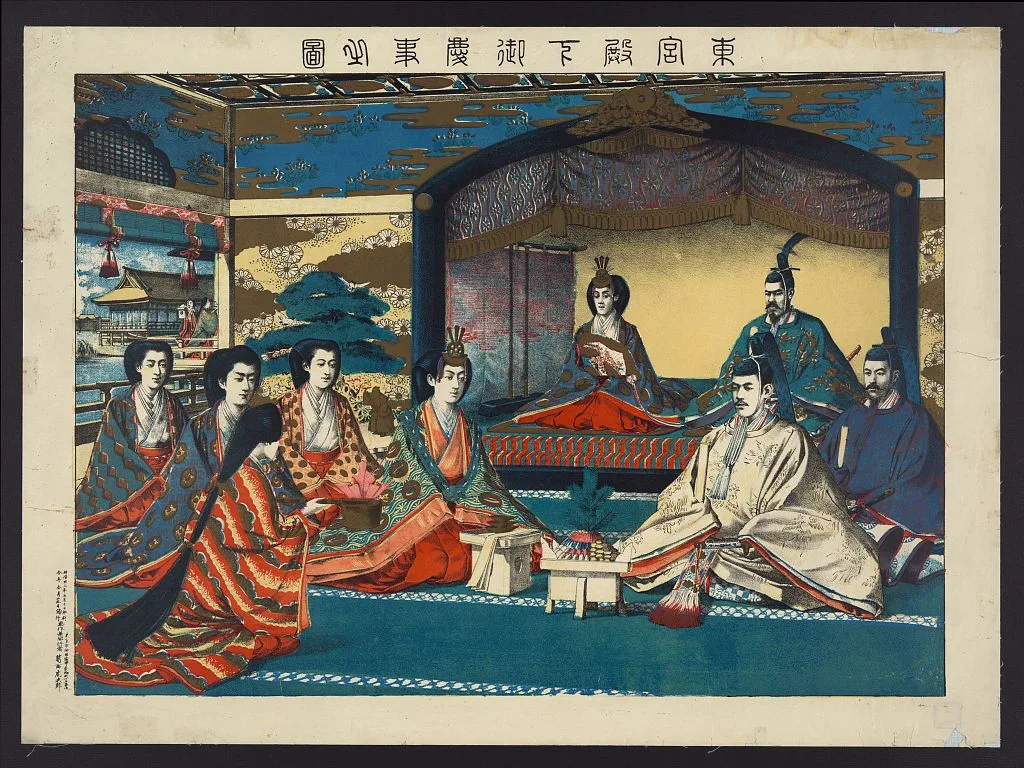
Crown Prince Yoshihito, the future Emperor Taishō, married Kujō Sadako in May 1900 before the kami in the Kashikodokoro, the palace sanctuary. Tokyo Daijingū, the shrine that owns this history, says it was the first wedding in the court's history held before the kami there, and that the shrine "created" a shrine wedding for ordinary people to commemorate it. Its own page adds the line that matters: before this, weddings were customarily held at home, so a solemn rite before the kami "drew people's attention as an epoch-making event."4
The Encyclopedia of Shinto gives the mechanics. The Imperial Household's investigative bureau researched and codified a liturgy, issued as the Imperial Household Marriage Edict of April 1900. On 3 March 1901 the Ise shrines' lay association staged a mock shinzen kekkon at the Tokyo shrine "as a workshop on the liturgy of the Crown Prince's wedding rites," revised it, and disseminated it.5 The Edo-period Ise and Ogasawara etiquette schools had already linked weddings loosely to the gods; the 1900 liturgy pulled that thread into a shrine, put a priest at the front, and kept the cups.5 By 1912 Natsume Sōseki was describing a Hibiya Daijingū wedding in a novel.4
Then it went mass-market. Kokugakuin's Kenji Ishii dates the boom to the mid-1950s through the early 1970s, when a Shinto rite at a hotel followed by a reception "were thought to be symbolic of a middle-class way of life" and replaced village celebrations that had run for days.6 From about 1989 the shrine wedding declined and the chapel rose, "a ritual that celebrates a marriage of love between individuals," chosen, he notes, by couples who are not Christian and do not intend to become so.6 A 2015 survey put Christian-style ceremonies at 64.3 percent and Shinto at 16.7.7 The "traditional Japanese wedding" was the majority choice for roughly one generation.
The white
The shiromuku is white from the outer robe to the socks. The Victoria and Albert Museum's label on a white wedding uchikake gives the meaning brides are told today: the colour stands for "the bride's willingness to adapt, or be 'dyed', to the ways of her groom's family," and after the shrine rite she changes into a coloured robe for the reception.8
The white is older than the shrine. Mitford's 1871 rulebook: "The dress of the bride is a white silk robe with a lozenge pattern, over an under-robe, also of white silk. Over her head she wears a veil of white silk, which, when she sits down, she allows to fall about her as a mantle."1 Chamberlain saw the same bride two decades later, "dressed all in white, the colour of mourning," and noted that she then "changes her white dress for one given to her by her husband."2 The costume change is in the old book too: "In old times the bride and bridegroom used to change their dress three or five times during the ceremony."1 The white veil in the 1871 text is the same idea as the wataboshi hood a bride wears today; the Kimbei photograph below has one.
The claim you will read everywhere, that the white robe began as samurai bridal wear in the Muromachi period, may well be right. It is not in any source we could open; the trail we could follow starts with an Edo etiquette manual. That is the honest starting date on this page.
Why your mother cares
Because the sake was always about the families. In the old rite the bride drank her nine sips a second time with her new parents, and the two bottles were poured into one kettle in front of everybody. If your mother wants the cups, she is not asking for a shrine or a priest; those came in 1900. She is asking for the part of the day where two houses drink from the same pot, which has been the point since before anyone wrote it down in English.
In May 1900 a crown prince drank from a cup in front of a sanctuary his family had never used for a wedding, and a shrine across town saw the newspaper. The rite people call ancient is one good idea, well copied.
Asked at the desk
What does san-san-kudo mean?
Literally "three, three, nine times": three sips from each of three stacked cups, shared by the couple. The oldest text we opened explains the poured-together sake as the union of two houses and gives no meaning for the number.1
Is a Shinto shrine wedding ancient?
No. Weddings were held at home until the Meiji era. The shrine form was codified for the crown prince’s wedding in 1900 and offered to the public at Tokyo’s Hibiya Daijingū from 1901.45
Why does a Japanese bride wear white?
The white robe and veil are prescribed in an Edo-period etiquette book, and museums today explain the colour as the bride’s readiness to be "dyed" by her new family. Nineteenth-century observers also called it the colour of mourning, since she was leaving her house.128
Who drinks first, the bride or the groom?
In the 1871 translation the groom drinks first and a note scolds the "popular tradition" that the bride should. Today many couples alternate or drink together; there is no shrine rule older than 1900 to break.1
The receipt
- A. B. Mitford (Lord Redesdale), Tales of Old Japan (London, 1871), appendix "The Marriage Ceremony (from the Shō-rei Hikki, Record of Ceremonies)," Project Gutenberg. gutenberg.org
- Basil Hall Chamberlain, Things Japanese, "Marriage" (first edition 1890; fifth edition, London: John Murray, 1905, pp. 309–314), Wikisource. en.wikisource.org
- "Shinzen kekkon," Basic Terms of Shinto, Kokugakuin University Digital Museum. d-museum.kokugakuin.ac.jp
- Tokyo Daijingū, 神前結婚式の創始 ("The origin of the shrine wedding"), the shrine’s own history page (Japanese). tokyodaijingu.or.jp
- Endō Jun, "Shinzenkekkon," Encyclopedia of Shinto, Kokugakuin University. d-museum.kokugakuin.ac.jp
- Kenji Ishii (Kokugakuin University), "Wedding choices reflect changes in postwar ritual culture," The Japan News, 27 November 2016, republished by Kokugakuin Media. kokugakuin.ac.jp
- "Weddings in Japan," Japan Glances, Nippon.com, 20 July 2015. nippon.com
- Victoria and Albert Museum, Kimono (white silk wedding outer kimono, uchikake), 1980–2000, O126701, collection record. collections.vam.ac.uk
Shelved 2026-09-05 · back to the wall