The invented ones
When did men start wearing wedding rings?
In America, the 1940s. Before World War II most weddings used one ring, the bride’s, and the Catholic rite blessed only hers. A 1926 jewelry-trade campaign for men’s engagement rings failed. A wartime publicity push for the "double ring service" did not: by 1947 about eighty percent of American weddings used two rings, up from fifteen. In parts of Europe men had worn them for decades.
Your grandfather's wedding ring, if he had one, is younger than the radio. That is not a guess. A historian named Vicki Howard went through the jewelry trade's own magazines and found the year the American groom's ring was sold to the country, and the year before that when it was not.1
.jpg)
One ring, for centuries
"Among Catholics and others prior to World War Two," Howard writes, "most marriage vows took place with one wedding band. The Roman Ritual called only for the blessing of the bride's ring."1 Her conclusion is blunt: the American double-ring ceremony "can be traced to the 1940s and 1950s when the jewelry industry invented the tradition of the groom's wedding band and the marrying public adopted it with a vengeance."1
1926: the he-man ring
The first attempt was an engagement ring for men. In May 1926 the trade paper The Jewelers' Circular reported a cooperative campaign out of Newark, New Jersey, to popularize "male engagement or betrothal rings."1 The plan was to run ads of "pretty girls giving the rings" and to "picture some 'he-men' wearing 'em."1 One Newark ad posed a male hand with a cigarette. The rings had names like the Pilot, the Advocate, the Master, the Executive and the Stag; a green-gold model called the Major was pitched at "the 'he-man' who appreciates true value."1
Men laughed. A shipping clerk at Strawbridge & Clothier was caught by coworkers "examining plain gold rings" and razzed in the company newsletter.1 "With such obstacles," Howard writes, "it is no wonder the practice never caught on. Soon after this 1926 campaign, the male engagement ring custom dropped from view."1 The groom's wedding band survived quietly in catalogs, and a 1937 etiquette book mentions a double-ring service, but it was a minority choice.1
Then the war
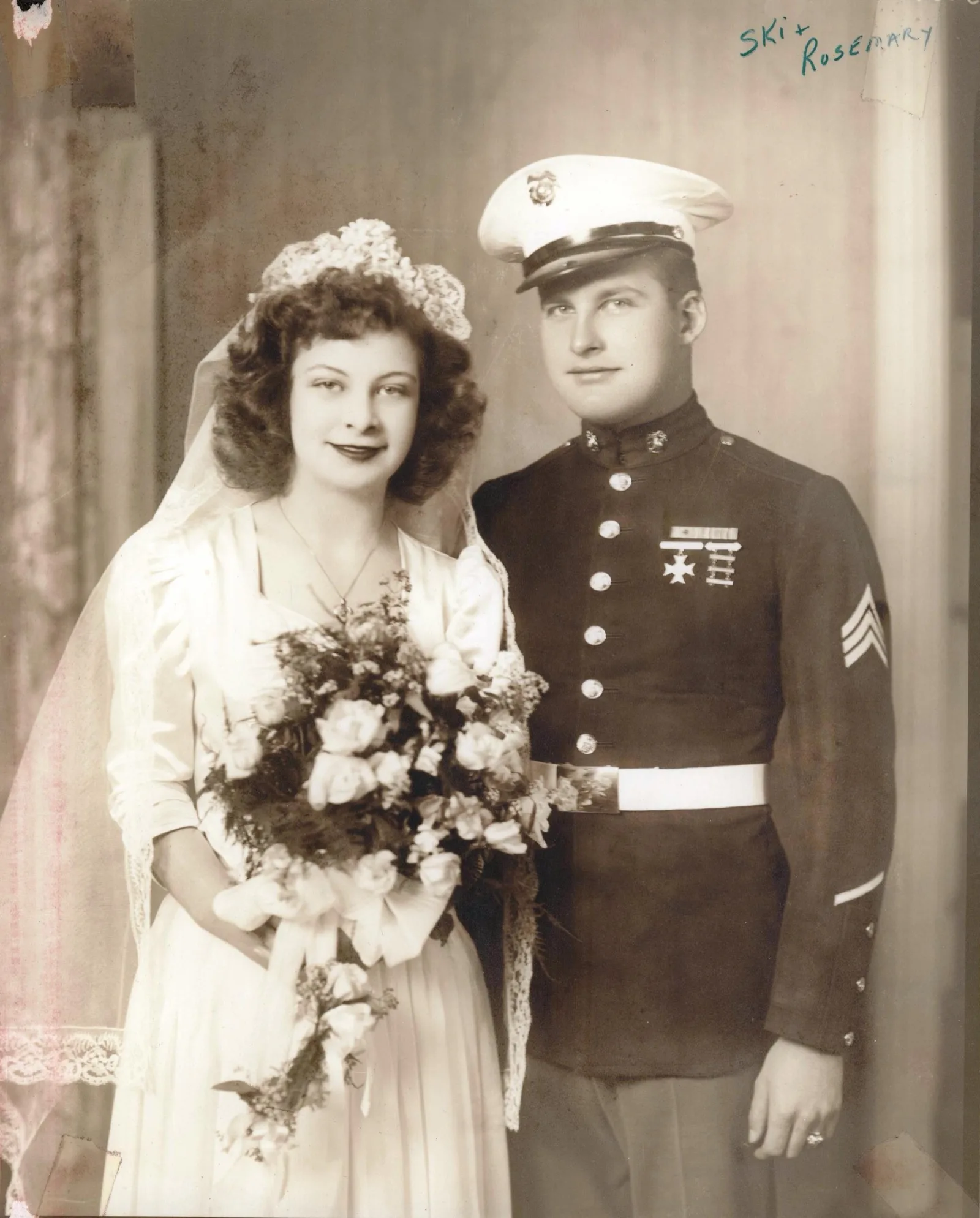
What the he-man could not do, the soldier did. During the Second World War the Jewelry Industry Publicity Board "campaigned widely to promote 'the story of the double ring service,'" using radio, trade press, movies and newsreels, and reaching "schools, clubs, factories, home economics departments and country newspapers."1 A January 1944 ad from J. R. Wood & Sons, the largest wedding-ring maker in the country, showed a soldier with a letter from home and called men in the armed services the "Most Important Post-War Influence."1 When the War Production Board cut jewelers' gold to half their 1941 use, Wood's president William Schwab fought the limit until it was raised and then lifted.1 Retailers credited the ring's new popularity to wartime feeling, "but they also helped shape the contours of this sentiment."1 Schwab had been planning to sell the double-ring ceremony before Pearl Harbor.1
The numbers moved fast. According to a November 1947 Fortune article titled "Ring Twice," double-ring weddings rose "from 15 to approximately 80 percent" between the end of the Depression and the late 1940s.1 Humphrey Bogart wore his first groom's ring when he married Lauren Bacall in 1946; Shirley Temple had a double-ring ceremony the same era.1 The churches caught up afterward: a priest asked in 1944 whether a second ring was even allowed, and the Vatican's Congregation of Sacred Rites did not formally permit the double-ring ceremony until 1956.1
Jimmy claims he hasn't yet been able to take it off. He says he tried to convince Doris of the danger of a mechanic wearing a ring while working at machines, but Doris refused to be convinced.A Maidenform company newsletter on a 1946 double-ring wedding in Bayonne, New Jersey1
The saleswoman's trick
In Fresno in 1946 a jeweler named Miss Bierman kept every men's ring "concealed in slide drawers beneath the feminine ring displays," because a man's ring "would 'clash' in this atmosphere," and never mentioned it "until the woman had made up her mind on her own rings."1 During the war women often bought the groom's ring themselves.1 The double ring was sold to brides, one drawer at a time.
Europe got there first
None of this was new abroad. German Jewish brides in the late nineteenth century lobbied their rabbis for a groom's ring "in order to bring a sense of equality to the ritual," and brides in First World War England debated whether men should wear rings "as was custom in many 'continental countries.'"1 Both spouses wearing a ring has been usual in Germany since at least the 1870s, and Orthodox Christians wear theirs on the right hand.23 America was the laggard that later called it ancient. A 1927 ring-company ad announced that "FASHIONABLE SOCIETY sanctions the return of the ancient custom of the double ring service."1 There was no such custom to return to.
Why your mother cares
If your grandmother married in the early 1950s, she was, on average, twenty years old, and the groom's band meant something specific to her. Howard puts it plainly: it "stood as a symbol of her success, as well as the man's willingness to participate in his new role," in a decade when women unmarried at twenty-one were called old maids.1 For him, the ring marked "his new role as husband and prospective father."1 A Fresno saleswoman reported that year that "the most rugged of men now cheerfully exhibit wedding rings, and many want them made up to exactly the same design as those worn by their wives."1 When your mother assumes the groom will wear one, she is assuming what her mother fought for.
In 1947 a magazine had to reassure readers that a man in a wedding ring could now be "perfectly acceptable." There was no feed to post him to.
Asked at the desk
Did men wear wedding rings before World War II?
Some did, especially in Germany and among Orthodox Christians. In America most weddings used one ring until the 1940s, and only about fifteen percent were double-ring ceremonies at the end of the 1930s.12
Where does the "15 to 80 percent" figure come from?
A November 1947 Fortune article, "Ring Twice," cited by the historian Vicki Howard in the Journal of Social History.1
Is the double-ring ceremony a Catholic tradition?
Not originally. The Roman Ritual blessed only the bride’s ring; the Vatican permitted a second ring in 1956, after American practice had already changed.1
Do men have to wear an engagement ring now?
No. Men’s engagement rings were tried in 1926 and failed; a 2014 industry survey put the share of engaged men wearing one at about five percent.4
The receipt
- Vicki Howard, "A ‘Real Man’s Ring’: Gender and the Invention of Tradition," Journal of Social History 36:4 (2003), pp. 837–856. Trade sources cited within: "Popularizing Engagement Rings for Men," The Jewelers’ Circular, 19 May 1926; "Ring Twice," Fortune, November 1947; J. R. Wood & Sons advertisement, Jewelers’ Circular-Keystone, January 1944. doi.org · JSTOR · summary at JSTOR Daily
- Wikipedia, "Wedding ring," on German practice since the 1870s (citing Chambers’s Journal, 1872). en.wikipedia.org
- Orthodox Church in America, "Wedding Bands," Questions and Answers. oca.org
- Samantha Zabell, "The Rise of the Man-gagement Ring," The Atlantic, 14 February 2014, reprinted by Northwestern University. news.northwestern.edu
Shelved 2026-09-05 · back to the wall