The rebranded ones
Why do brides wear white?
Because Queen Victoria wore white satin and Honiton lace on 10 February 1840, and the pictures went everywhere. White brides existed before her, and for the wealthy white already signaled refinement, but most women married in their best dress in any color. The "purity" meaning was attached afterward, and the white wedding became standard only when the American wedding industry made it so between the 1920s and 1950s.
Ask why the dress is white and someone will say purity, and someone else will say Queen Victoria, and both will be a little wrong in the same direction. The white dress is one of the best documented traditions on these shelves, because a museum still has it, the bride kept a diary, and the people who later sold it wrote everything down.
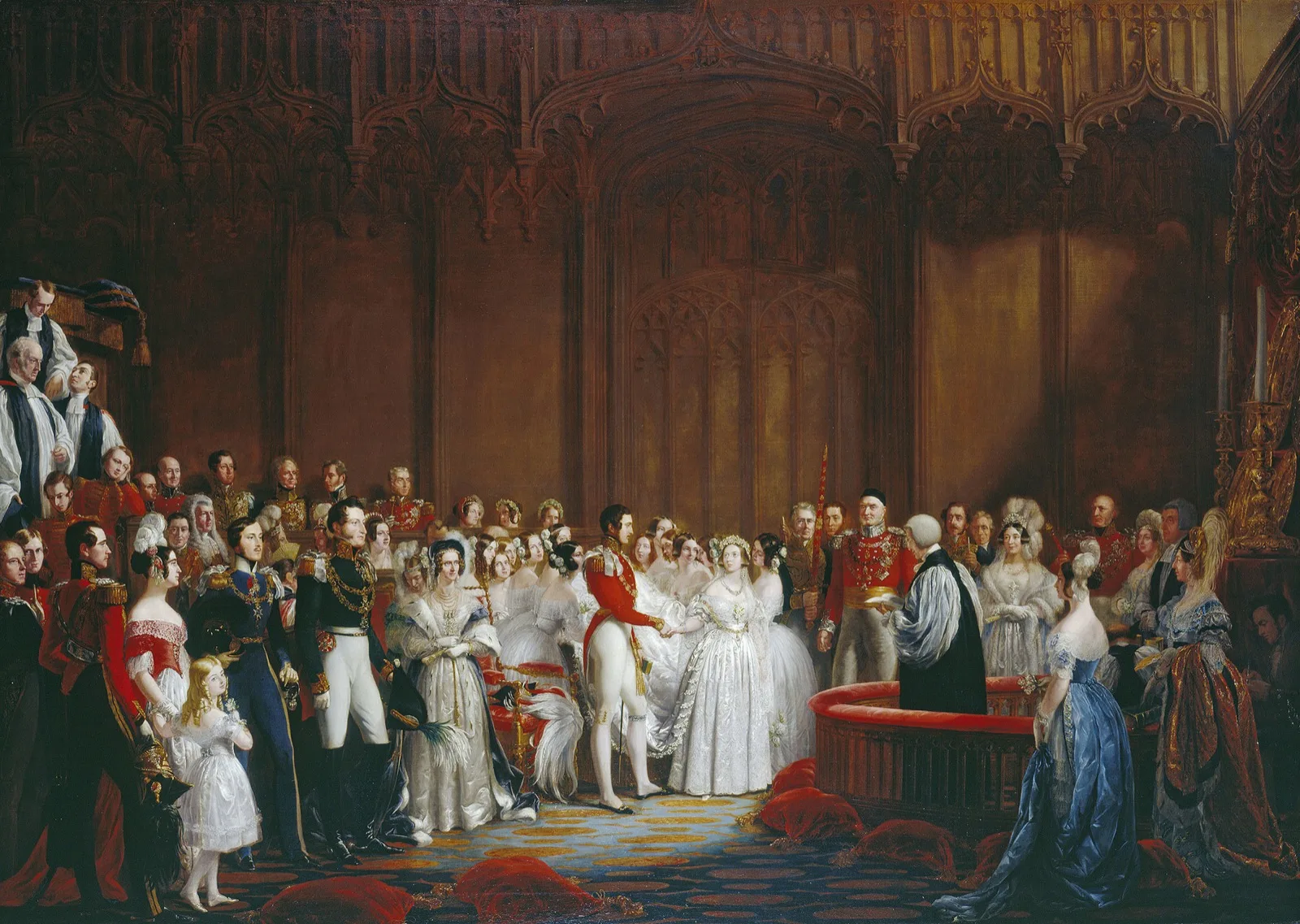
_-_The_Marriage_of_Queen_Victoria,_10_February_1840_-_RCIN_407165_-_Royal_Collection.jpg)
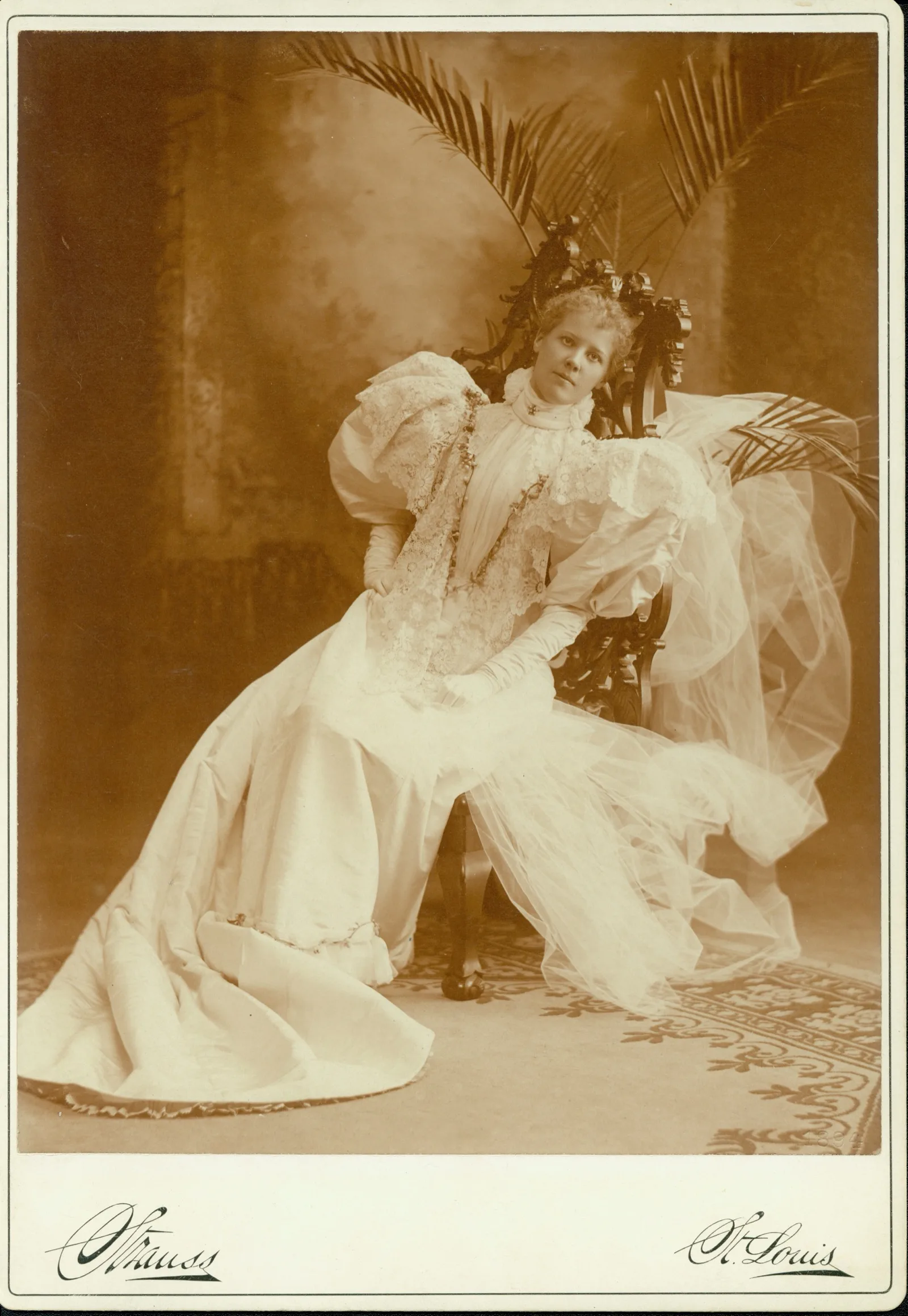

What brides wore before 1840
Their best dress. "From the Middle Ages to the mid-19th century," writes Marlise Schoeny of Ohio State's historic costume collection, "most brides simply wore their best dress or purchased a new gown that could be worn again."1 A new dress, if there was one, went on to be Sunday best or was altered until it wore out, and even Victoria repurposed hers afterward.2 Royal brides were the exception, and they did not wear white either. They wore silver and gold "as a sign of their royalty"; Princess Charlotte's 1816 gown was "completely covered in silver and gold metallic threads."3
There were white brides before Victoria. Mary, Queen of Scots married the Dauphin of France at Notre-Dame on 24 April 1558 in "a robe whiter than the lily," according to the nineteenth-century historian Agnes Strickland.4 And by around 1800, among people who could afford it, white or cream had come to imply "purity, cleanliness and social refinement," in the words of a Victoria and Albert Museum object record.5 The key phrase is "who could afford it." Less well-off Victorian brides "often preferred more practical coloured gowns."5
10 February 1840
Victoria was twenty, and she broke with the coronation-robe custom for her own wedding to Prince Albert.1 Her journal records what she chose: "I wore a white satin gown with a very deep flounce of Honiton lace, imitation of old. I wore my Turkish diamond necklace and earrings, and Albert's beautiful sapphire brooch."3 The lace was an act of policy as much as taste. The crown commissioned the painter William Dyce to design it, and the flounce "employed two-hundred lacemakers, who were otherwise destitute."3 The Devon lace trade was dying. The Queen's dress was a relief program with a train.
The gown "was featured in newspapers and magazines around the world."1 That is the whole mechanism. Victoria did not invent white; she was the first white bride whose picture everyone saw. And she wore the lace for the rest of her life, at the christenings of her children, at her daughter Beatrice's wedding in 1885, and in 1847 she sat for a portrait "wearing my dear wedding veil."6 When she died in 1901 the veil went into the coffin over her face.6
Nine years later, "from the earliest ages"
In 1849 the Philadelphia magazine Godey's Lady's Book told its readers that "custom has decided, from the earliest ages, that white is the most fitting hue" for a bride, "an emblem of the purity and innocence of girlhood, and the unsullied heart she now yields to the chosen one."2 Nine years after Victoria, the color had been ancient forever. Summer Brennan, writing for JSTOR Daily, calls this what it is: revisionist history, Victorian ideals projected backward.2 Schoeny is blunter about what white meant at the time: it "became a sign of wealth and status rather than virginity."1
Then somebody made it a business
The white wedding as a rule, not a fashion, is a twentieth-century American product. The historian Vicki Howard traces the wedding industry's birth to the years between the 1920s and the 1950s, when "bridal magazine editors and etiquette writers, jewelers, department store window display artists, bridal consultants, fashion designers, and caterers invented new consumer rites and promoted higher standards of wedding consumption."7 During the Second World War the gown makers lobbied successfully for an exemption from fabric restrictions, arguing that a white gown was vital to morale, and the industry linked "the diamond engagement ring, the double-ring ceremony, and the formal white wedding gown with democracy and American prosperity."71 "By the 1950s," Howard writes, the formal white wedding was "a part of a new cult of marriage and the modern American Dream."7 By one industry count, about 83 percent of brides wore white in 2018.1
Why your mother cares
Before the war many American brides "married in their parents' home in their best dress, regardless of the color."8 Your grandmother's generation was the first for whom the white gown was simply what a wedding was, and Schoeny's summary of what it meant to them is worth reading twice: from the war "through the end of the 20th century, the white gown symbolized prosperity, virginity and a lifetime commitment to one person."1 The fifties gave her "yards of gathered skirting, laces, sweetheart and off-the-shoulder necklines"; the seventies gave her daughter polyester.9 One family wore the same gown in 1955, 1984 and 2018, and the mother in the middle said seeing her daughter in it "filled me with a feeling of warmth for the family bonds that we had over time."10 That is what your mother means by white. Not purity. Continuity.
Victoria's dress went around the world in engravings, at the speed of ships. It took nine years for a magazine to call it ancient.
Asked at the desk
Did Queen Victoria invent the white wedding dress?
No. White brides are documented earlier, including Mary, Queen of Scots in 1558, and white already signaled refinement among the wealthy by about 1800. Victoria made it fashionable and famous.45
Does a white dress mean virginity?
That meaning was attached in the decade after Victoria; an 1849 magazine called it an emblem of "purity and innocence." Costume historians say white read as wealth and status first, because it was expensive to keep clean.12
When did the white wedding become standard?
Between the 1920s and the 1950s, when the American wedding industry took shape and made the formal white wedding the norm.7
What did Queen Victoria’s dress look like?
White satin with a deep flounce of Honiton lace designed by William Dyce, made by about two hundred Devon lacemakers, worn with a sapphire brooch from Albert.3
The receipt
- Ohio State University News, "Why do brides wear white?" (Marlise Schoeny, Historic Costume and Textiles Collection). news.osu.edu
- Summer Brennan, "A Natural History of the Wedding Dress," JSTOR Daily, quoting Godey’s Lady’s Book (1849). daily.jstor.org
- Summer Lee, "1840 – Queen Victoria’s Wedding Dress," Fashion History Timeline, Fashion Institute of Technology, quoting Queen Victoria’s journal. fashionhistory.fitnyc.edu
- Claire Ridgway, "24 April 1558 – The marriage of Mary, Queen of Scots, and the Dauphin of France," The Tudor Society, quoting Agnes Strickland (1852). tudorsociety.com
- Victoria and Albert Museum, object record O1223045, wedding veil of Honiton lace, 1865. collections.vam.ac.uk
- Royal Central, "Queen Victoria’s wedding veil," quoting Susan Reid’s account of 1901. royalcentral.co.uk
- Vicki Howard, Brides, Inc.: American Weddings and the Business of Tradition (University of Pennsylvania Press, 2006), publisher’s description. pennpress.org
- Johnson County Museum, "The White Wedding: A New Postwar Tradition," 2025. johnsoncountypost.com
- St. James Encyclopedia of Popular Culture, "Wedding Dress," via Encyclopedia.com. encyclopedia.com
- Chrissy Callahan, "1950s wedding gown worn by 3 generations of brides," Today.com, 19 February 2020. today.com
Shelved 2026-09-05 · back to the wall