The rebranded ones
Where does jumping the broom come from?
The earliest documented broomstick weddings are in the British Isles, especially Wales, where the custom was called priodas coes ysgub; a 1559 Bruegel painting shows a couple marrying under a broom. Enslaved people in the American South, denied legal marriage, made the broom their own, and more than a hundred described it to interviewers in the 1930s. It faded after emancipation and returned in 1977, with Roots.
If you have read that jumping the broom began in Ghana, or among the Asante, you have read a story with no receipt. The historian who spent a decade tracing it, Tyler Parry, went looking for the African origin and found the evidence pointed somewhere else: "Finding that the evidence for jumping the broom's 'origins' pointed to western Europe, I wanted to better understand how groups adopted and adapted rituals for their own communal needs."3 That second half of his sentence is the real story, and it is better than the myth.

.jpg)
A painting, a hillside, a broom held by the father
In 1559 Pieter Bruegel the Elder painted Netherlandish Proverbs, a crowded canvas of Flemish sayings, and in one corner a couple kisses beneath a broomstick: marrying under the broom.2 The custom was documented most firmly in isolated pockets of Wales, where communities called it priodas coes ysgub, the broomstick wedding.25 A folklorist recorded in 1928 that the ritual had survived "until recently," with the groom jumping over a branch of flowering broom into the house first, "and afterwards the young woman."4 Romani families in Britain kept a version too; in one 1912 account the broom "was held by the father of the bridegroom or bride."4
What it became in America
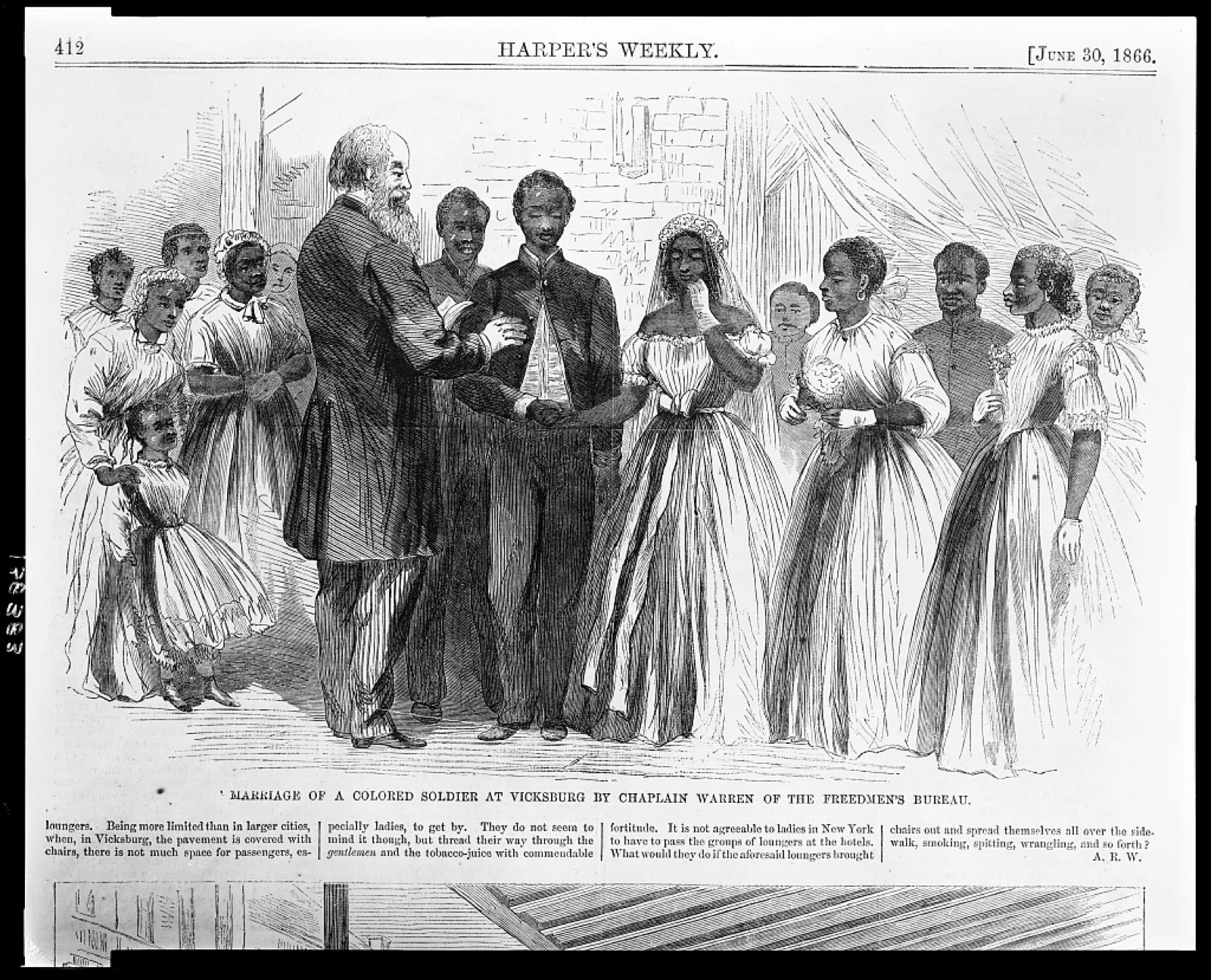
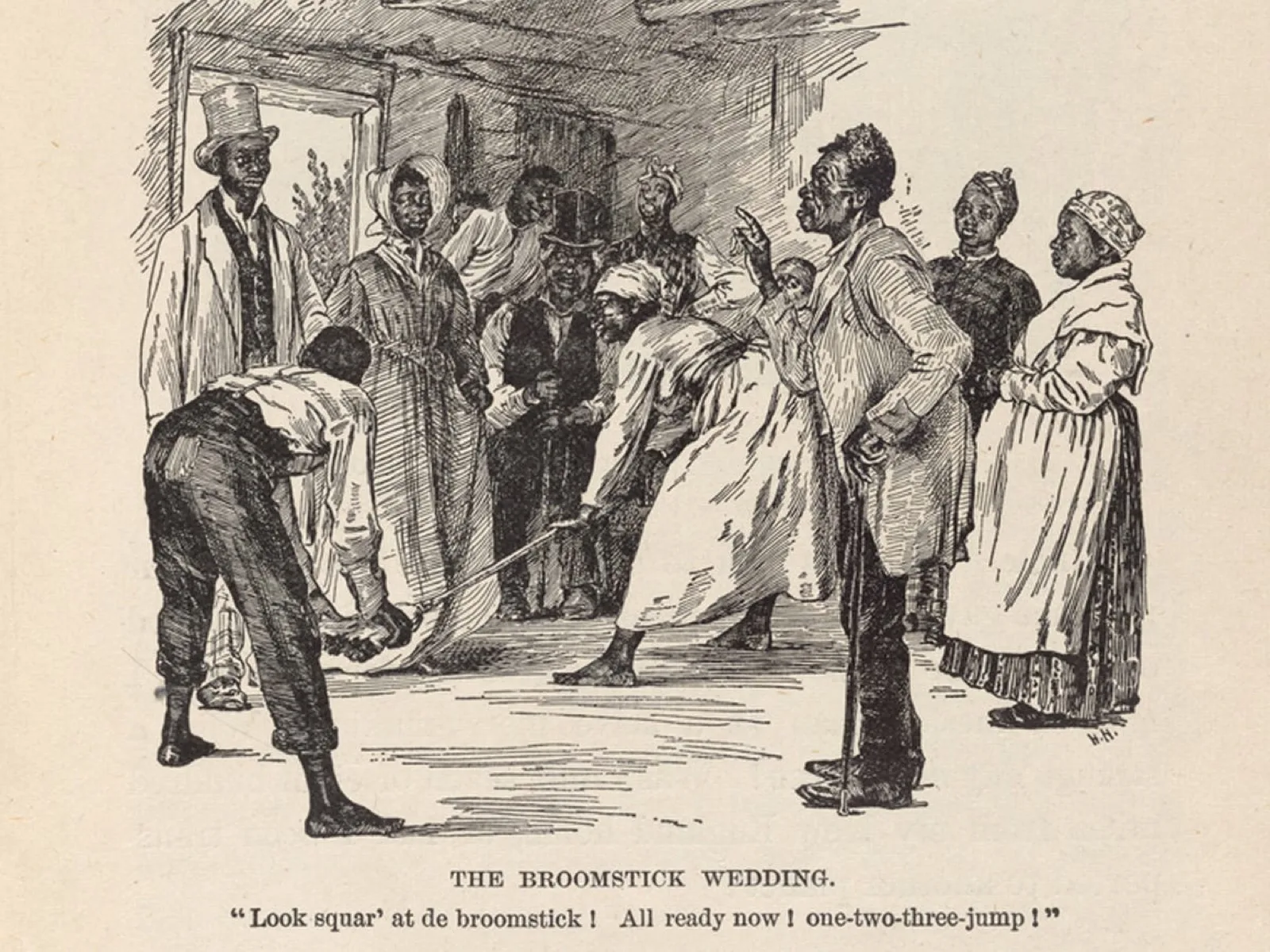
Enslaved people in the American South were legally chattel, "devoid of any civil or human rights," and the law would not marry them.7 They married anyway. When the Federal Writers' Project interviewed formerly enslaved people in the 1930s, the broom came up well over a hundred times.4 James V. Deane, interviewed in Baltimore on 20 September 1937: "I have seen many slave weddings, the master holding a broom handle, the groom jumping over it as a part of the wedding ceremony."6 Josephine Anderson, in Tampa a month later: "Mos folks dem days got married by layin a broom on de floor an jumpin over it. Dat seals de marriage, an at de same time brings em good luck."6 Cordelia Thomas, eighty years old in Athens, Georgia, remembered her mother saying couples "jus' jumped backwards over a broomstick whilst deir Marster watched and den he pernounced dat dey was man and wife."6
Not everyone told it that way. Josephine Ryles of Galveston had heard the talk "but it ain't true. No'm, dats jus' a story."4 The ritual was not universal. Where it was used, it was a practical answer to a legal wall, and some who used it ranked it above the marriage the law finally allowed: interviewed nearly eighty years after abolition, some said their broomstick weddings "were not only equal to their post-emancipation marriages" but "actually superior to them."2
Exeter done made me a weddin' ring. He made it out of a big red button wid' his pocket knife... it looked like a red satin ribbon tide roun' my finger.Tempie Herndon Durham, North Carolina, interviewed 1937. She and her husband also jumped the broom.7
A hundred years of silence, then a television set
After the Civil War the custom was largely abandoned for over a hundred years.4 Then, in the last week of January 1977, a hundred million Americans watched the finale of Roots, and earlier in the series Kunta Kinte had married Bell by jumping across a broom.8 "Knowledge of the tradition waned until 1977," Parry writes, "when it was reintroduced through the Roots television miniseries."2 In 1993 Harriette Cole, a lifestyle editor at Essence, published Jumping the Broom: The African-American Wedding Planner, "which spurred mass embrace."29
Whose is it
Parry's answer is the one worth keeping. Where a folk custom started, among people "who left few self-authored documents," is nearly impossible to fix; what matters is how each community "engaged with the custom historically, and how they have viewed its importance for their identity across generations."2 Black couples who jump the broom today do it to pay "homage to the resilience and bravery of their enslaved ancestors."3 A broom on a Welsh hillside in 1850 and a broom on a Georgia floor in 1850 were the same object. They were not the same act.
Why your mother cares
If your mother or grandmother married after 1977, the broom came to her through a television screen and then a wedding planner on the bookstore shelf. It was a way of standing in a line of people who married when marriage was forbidden to them. That is not a decoration. When she asks whether you will jump, she is asking whether the line continues.
A hundred people described it to strangers in 1937, in their own words, with no picture taken. Those words are the record.
Asked at the desk
Did jumping the broom start in West Africa?
No source supports that. The earliest documented broomstick weddings are in Wales and among British Romani, and a 1559 Bruegel painting shows the custom in Flanders.12
Did all enslaved couples jump the broom?
No. It appears more than a hundred times in the 1930s interviews, but some narrators denied it; one called it "jus’ a story."4
The receipt
- Tyler D. Parry, Jumping the Broom: The Surprising Multicultural Origins of a Black Wedding Ritual (Chapel Hill: University of North Carolina Press, 2020). uncpress.org
- Tyler D. Parry, "Broomstick weddings and the history of the Atlantic world," Aeon, 14 December 2020. aeon.co
- Holly A. Pinheiro Jr., "Black Americans and Wedding Rituals: An Interview with Tyler D. Parry," African American Intellectual History Society, 21 November 2022. aaihs.org
- Tyler D. Parry, "Jumping the Broom and the American Cultural Divide," African American Intellectual History Society, 7 February 2018. aaihs.org
- Ras Michael Brown, review of Parry, American Historical Review 128:1 (2023). academic.oup.com
- Federal Writers’ Project, Slave Narratives (1936–38): Maryland (James V. Deane), Florida (Josephine Anderson), Georgia vol. IV pt. 4 (Cordelia Thomas), Project Gutenberg. Maryland · Florida · Georgia
- Angelita D. Reyes, "Antebellum Plantation Weddings Among Enslaved Women and Men," National Trust for Historic Preservation, 18 October 2021. savingplaces.org
- Wikipedia, "Roots (1977 miniseries)." en.wikipedia.org
- Harriette Cole, Jumping the Broom: The African-American Wedding Planner (New York: Henry Holt, 1993); catalog record via Open Library. openlibrary.org
Shelved 2026-09-05 · back to the wall