The rebranded ones
Why do brides wear veils?
The Roman bride wore the flammeum, a veil in a color Pliny compared to egg yolk, the same garment worn by the wife of Jupiter’s priest, and it was read as a good-luck charm. Medieval English couples knelt under one cloth together. For centuries most brides wore bonnets; the lace veil returned as a Victorian luxury, made famous in 1840. The evil-spirits story has no source.
You will be told the veil hid the bride from evil spirits, or from a groom who might bolt if he saw her face in an arranged match. Neither story has a source. What the sources actually show is stranger and better: a yellow veil borrowed from a priestess, a linen cloth over two heads, a Bible story about the wrong sister, and a queen who was buried in hers.

,_1820_(CH_18184631).jpg)
Rome: the flame-colored veil
The Roman bride's veil was the flammeum. Pliny the Elder, listing the honors of colors, says the yellow he calls luteus held the oldest, reserved entirely for women in their bridal veils.1 He compared the shade to egg yolk; scholars still argue whether that means yellow or something pinker.2 The important detail is who else wore it. The flammeum was also the garment of the Flaminica Dialis, the wife of Jupiter's priest, whose marriage could never be dissolved, so on a bride it was read as an auspicious charm, a wish for a marriage like hers.2 Not a shield against demons. A costume borrowed from the one Roman wife who could not be divorced.
The Middle Ages: one cloth, two heads
In the English Sarum rite the couple knelt together during the nuptial Mass "with a fine linen cloth laid over their heads," a custom recorded at the wedding of Richard and Isabella in 1321.3 That cloth is still in the Catholic rite. The current Order of Celebrating Matrimony allows, before the nuptial blessing, "the blessing and placing of the lazo or the veil," a tradition kept by Hispanic and Filipino families, in which "a veil is placed over the head of the wife and the shoulders of the husband, thus symbolizing the bond that unites them."4 The blessing calls it "a symbol of the indissoluble union."5 A veil over both of you is older, in the church, than a veil over one.
Why the groom looks first
At an Ashkenazi Jewish wedding the groom veils the bride himself, in a ceremony called the bedeken, just before they go under the chuppah.6 It is custom, not law, and the reason given is Genesis 29. Jacob worked seven years for Rachel and woke the morning after the wedding beside her sister: "When morning came, it was Leah!"7 So the groom looks at the bride before he covers her face, to confirm she is the woman he means to marry.68 Chabad adds the gentler meaning: the veil says the groom "is not solely interested in the bride's external beauty, which fades with time; but rather in her inner beauty which she will never lose."8
Then, for centuries, a bonnet
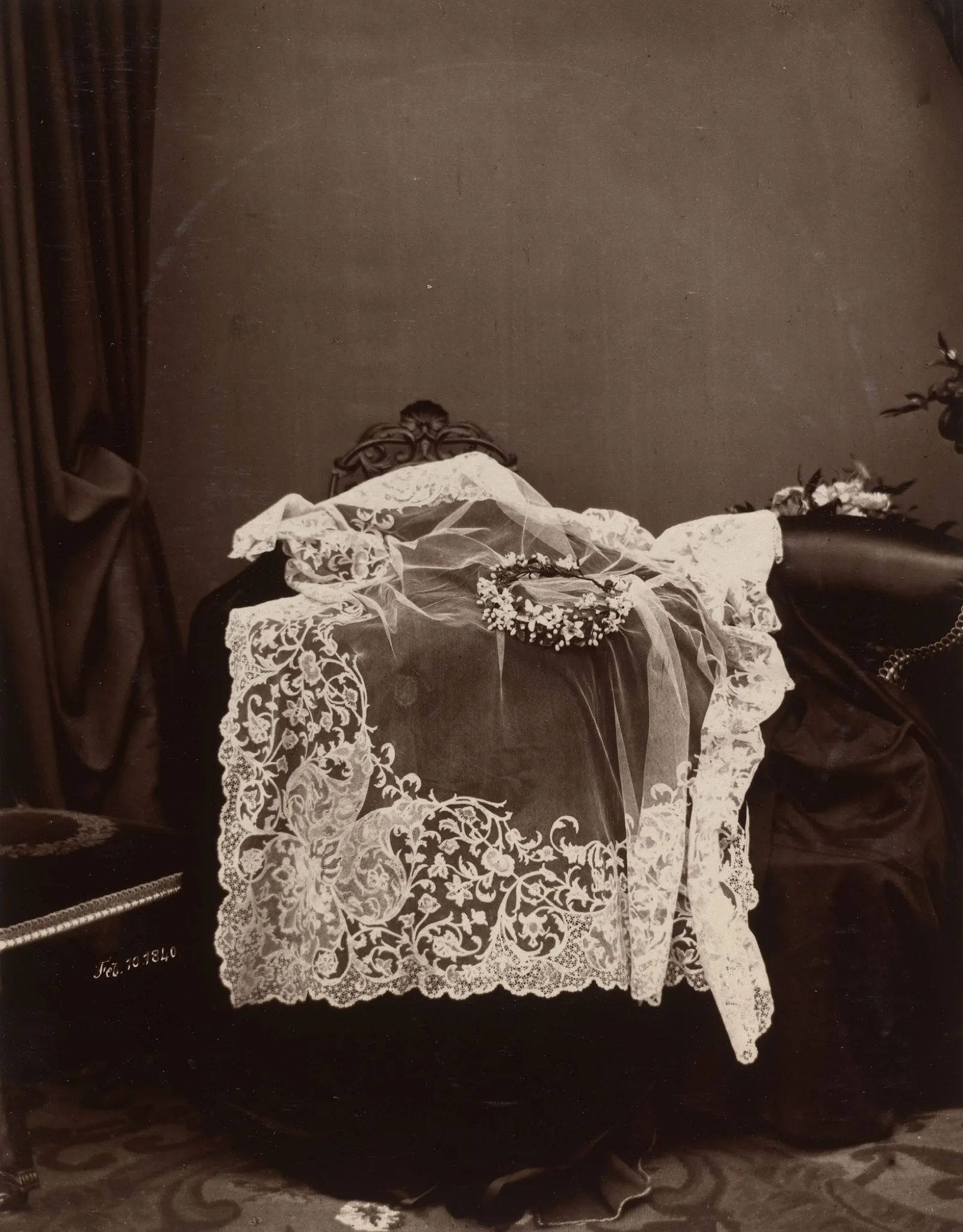
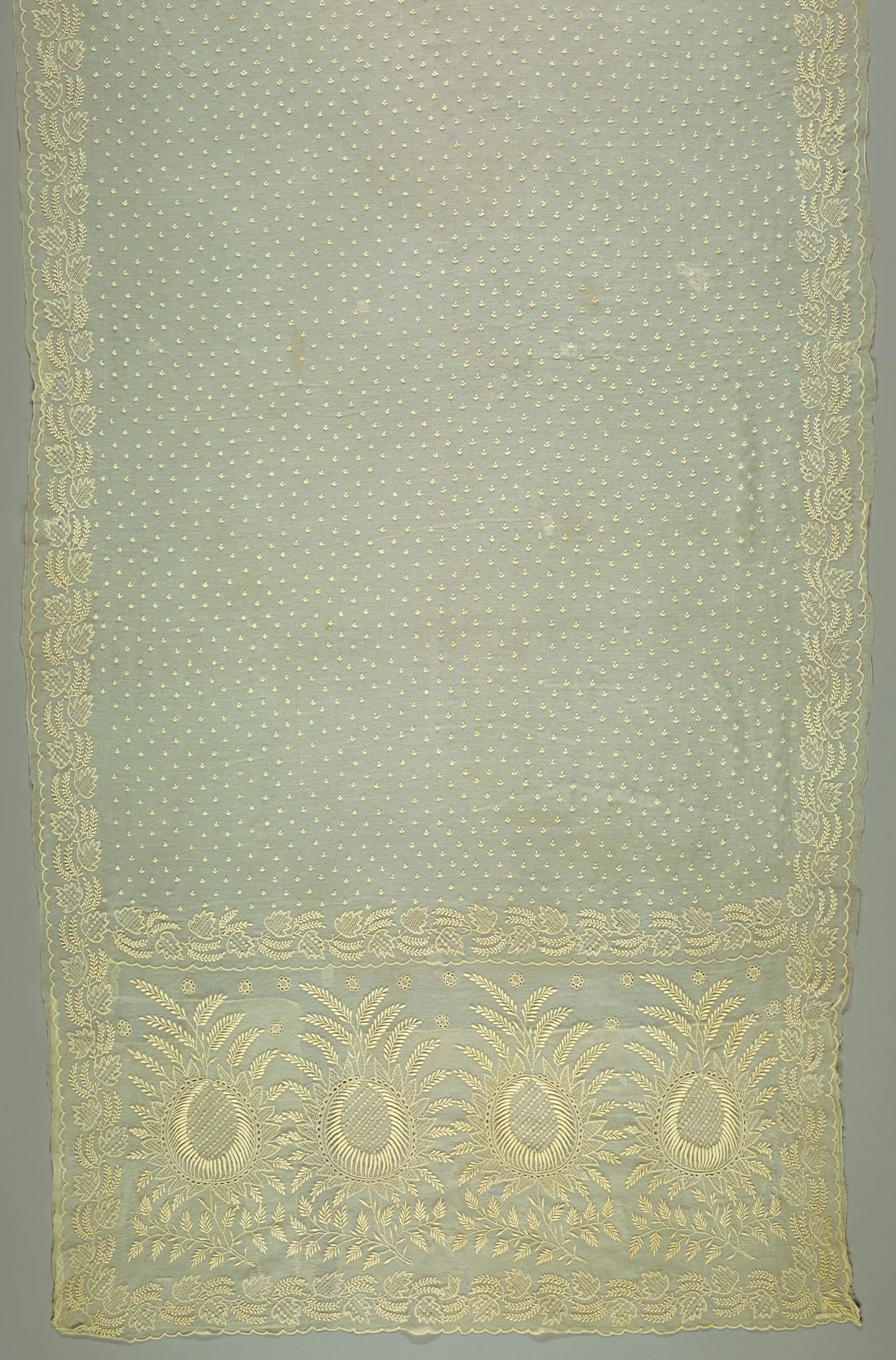
Before the nineteenth century, British brides mostly married in bonnets; a lace veil was a luxury few could buy.9 Handmade lace "was a status symbol that demonstrated wealth and position."10 Then Victoria married in 1840 in white satin "trimmed with orange-flower blossoms" and "a beautiful veil of Honiton lace," and by mid-century "the veil and orange blossom wreath were the essential accessories."119 The flowing veil came into vogue with the train in the mid-1870s.12 Victoria wore her lace at her children's christenings and sat for a portrait in 1847 "wearing my dear wedding veil"; when she died in 1901, a lady of the household saw her laid out with "her wedding veil over her face."13
One royal veil ended up in Washington. On 10 May 1881 Princess Stéphanie of Belgium wore a hundred by a hundred and twenty-three inches of handmade lace, its border carrying twenty-one coats of arms, to marry Crown Prince Rudolf of Austria; the veil is now in the Smithsonian.14
Why your mother cares
The Victorians attached the purity meaning, the "blushing, pure bride" the V&A's curator describes, and the mid-century white wedding carried it to your grandmother in yards of lace.9 If your mother saved hers, that is the object she is offering when she asks whether you will wear one. Wear it, or wear it as a cathedral-length thing over both of you at the altar the way the 1321 couple did, and tell her which century you picked.
Pliny wrote down the color of the bride's veil in the first century. It is the oldest wedding fashion note that survives, and there is no picture of it.
Asked at the desk
Did the veil protect the bride from evil spirits?
No historical source says so. The Roman flammeum was linked to the priestess of Jupiter and read as a good-luck charm; the evil-spirits story circulates on wedding sites without a source.2
What color was the Roman bridal veil?
Pliny calls it luteus, which he compared to egg yolk; historians debate whether that means yellow or a pinkish shade.12
The receipt
- Pliny the Elder, Naturalis Historia 21.22 (Latin text), LacusCurtius, University of Chicago. penelope.uchicago.edu
- Wikipedia, "Flammeum," citing Karen K. Hersch, The Roman Wedding (Cambridge University Press, 2010) and Festus. en.wikipedia.org
- Wikipedia, "Care cloth," citing Blount’s Glossographia (1681) and Michael P. Foley, Wedding Rites (2008). en.wikipedia.org
- USCCB, For Your Marriage, "The Order of Celebrating Matrimony Within Mass." foryourmarriage.org
- Fr Randy Stice, "The Wondrous Design of Your Love, Part II," Adoremus, September 2016, quoting OCM 71B. adoremus.org
- Rabbi Sari Laufer, "Ask the Expert: Veiled Bride," My Jewish Learning. myjewishlearning.com
- Genesis 24:65 and 29:21–25 (NRSVUE), Bible Gateway. biblegateway.com
- Chabad.org, "Badeken: Veiling." chabad.org
- Susanna Cordner, "A Romantic Frame of Mind," Victoria and Albert Museum blog, 11 February 2015. vam.ac.uk
- Victoria and Albert Museum, object record O87097, Brussels lace wedding veil, 1850–60. collections.vam.ac.uk
- Victoria and Albert Museum, object record O1223045, Honiton lace wedding veil, 1865, quoting a period report of the 1840 royal wedding. collections.vam.ac.uk
- St. James Encyclopedia of Popular Culture, "Wedding Dress," via Encyclopedia.com. encyclopedia.com
- Royal Central, "Queen Victoria’s wedding veil," quoting Susan Reid. royalcentral.co.uk
- Smithsonian Insider, "Hapsburg Imperial Bridal Veil," 5 June 2012. insider.si.edu
Shelved 2026-09-05 · back to the wall