The ceremony itself
Why do we throw rice at weddings, and does it hurt birds?
Throwing grain at a couple is old: seventeenth-century English guests cast wheat on the bride’s head "as presaging plenty," and Roman grooms scattered nuts for the boys. Rice does not hurt birds. The scare began with a 1985 Connecticut bill, spread through a 1988 Ann Landers column, and was answered by a Cornell ornithologist and a 2005 study that fed sixty birds nothing but rice.
You have been told not to throw rice because it swells in a bird's stomach and the bird dies, and somebody has probably suggested birdseed in a tulle bag. Both the custom and the panic have a paper trail, and the paper trail is funnier than the myth.
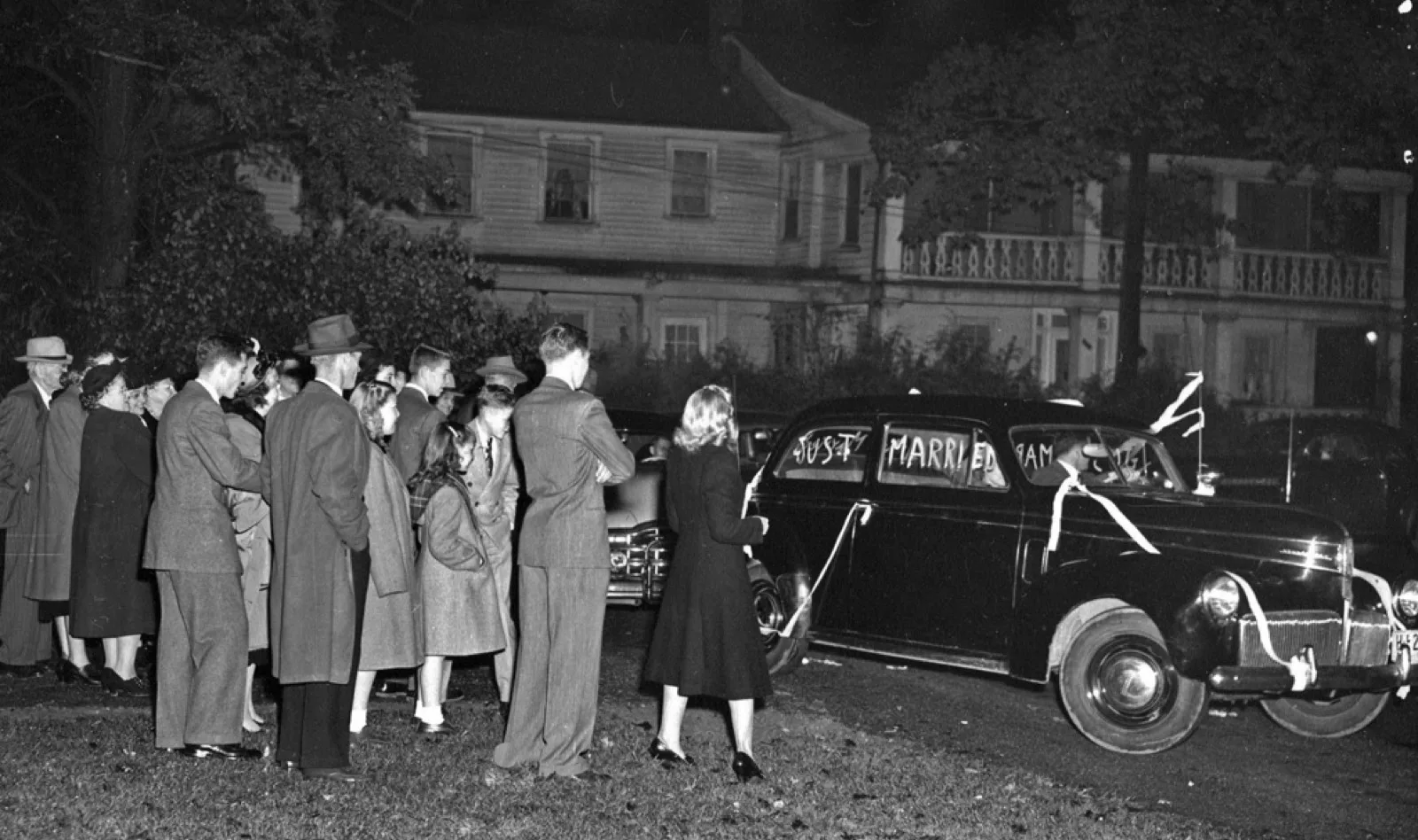



Nuts, then wheat
The Romans did not throw rice. At a Roman wedding "the bridegroom threw nuts about the room for the boys to scramble," the antiquary John Brand recorded, "a token that the party scattering them was now leaving childish diversions."1 Catullus put it in his wedding hymn: "Give nuts to the boys, O listless favorite; long enough have you played nuts."2
The grain arrives in England. In 1655 Thomas Moffet wrote that the English, "when the bride comes from church, are wont to cast wheat upon her head; and when the bride and bridegroom return home, one presents them with a pot of butter, as presaging plenty."1 The poet Robert Herrick had already set the scene in 1648: guests who "bless you, sprinkling you with wheat."1 Wheat for plenty, butter for the house. Rice came later, as a cheaper grain, and no source opened for this shelf pins the date.
Newtown, Connecticut, 1985
The bird story has a birthday. In 1985 State Representative Mae S. Schmidle of Newtown filed "An Act Prohibiting The Use Of Uncooked Rice At Nuptial Affairs," which read that "no person shall throw, fling, cast or hurl any uncooked rice at any time during the celebration of any marriage," with a fifty-dollar fine.3 Her evidence: "I've heard from several ministers who say that the next morning after a wedding, they see all these birds toppled over because they got poisoned by the rice."3 A past president of the Connecticut Audubon Society, Roland Clement, answered on the spot: "It sounds crazy. I have 50 years of professional experience as a practicing ornithologist and I've never heard of such a thing before."3 The bill did not pass.4
Ann Landers, and the man from Cornell
In 1988 Ann Landers told her readers, "Please encourage the guests to throw rose petals instead of rice. Rice is not good for the birds."35 Steven C. Sibley of the Cornell Laboratory of Ornithology wrote in. "Rice is no threat to birds. It must be boiled before it will expand. Furthermore, all the food that birds swallow is ground up by powerful muscles and grit in their gizzards. Many birds love rice, as any frustrated rice farmer will tell you."3 He added that the rumor had frightened "thousands of brides into putting birdseed in little tulle and chiffon bags."3 Landers printed a retraction: "Shame on me for going along with that crock. I feel like a birdbrain."3 Then, in 1996, she ran the myth again.5
So a biology professor tested it. James Krupa of the University of Kentucky, pushed by his students, fed sixty doves and pigeons nothing but instant rice and water for a day. None "showed any obvious signs of pain, discomfort, or distress; none of them exhibited ruptures or other injuries (including explosion), and none of them took ill or died."36 Soaked rice expanded 33 percent in volume; ordinary birdseed expanded 40.3 The paper's title names Ann Landers, Martha Stewart and Bart Simpson.6
Why venues still say no
Because rice on a stone step is a broken hip. The rules "work to keep the properties clean," and rice on a hard floor "puts anyone who walks across that surface at risk of taking a nasty spill."3 Ask the venue what they allow before you buy anything in a tulle bag.
Why your mother cares
If your mother married after 1988, she was one of Sibley's thousands: she bought the birdseed because a newspaper told her to, and she probably still believes it. Your grandmother threw rice, or had it thrown, and heard the older meaning, the one Moffet wrote down: plenty, and abundance of all good things. Tell your mother the birds are fine. Then throw whatever the venue lets you, for plenty.
A poet in 1648 described the wheat coming down. A Frenchman in 1698 described the posset. Nobody needed a slow-motion exit shot to remember the send-off.
Asked at the desk
Does uncooked rice hurt birds?
No. Rice must be boiled to expand, birds grind food in their gizzards, and a 2005 study that fed sixty birds only rice found no harm.36
Where did the rice-and-birds myth come from?
A 1985 Connecticut bill to ban rice throwing, then a 1988 Ann Landers column, which she retracted and later repeated.35
Did the Romans throw rice?
They threw nuts. The English threw wheat by the 1600s "as presaging plenty."12
Why do venues ban rice?
Cleanup and slip hazards on hard floors, not birds.3
The receipt
- John Brand, ed. Henry Ellis, Observations on the Popular Antiquities of Great Britain, vol. 2 (1849), "Ring and Bridecake," quoting Thomas Moffet, Health’s Improvement (1655), and Robert Herrick, Hesperides (1648). archive.org
- Catullus, Carmina 61, trans. L. C. Smithers (1894), Perseus Digital Library, Tufts University. perseus.tufts.edu
- David Mikkelson, "Is Throwing Rice at Weddings Bad for Birds?", Snopes, 14 May 2000. snopes.com
- Kat Hong, "Throwing rice at weddings has a complicated history," Upworthy, 30 June 2026. upworthy.com
- The Straight Dope, "Should you not throw rice at weddings because birds swallow it and explode?" straightdope.com
- James J. Krupa, "A Classroom Exercise for Testing Urban Myth: Does Wedding Rice Cause Birds to Explode or Were Ann Landers, Martha Stewart & Bart Simpson Wrong?", The American Biology Teacher 67:4 (2005), pp. 223–230. doi.org
Shelved 2026-09-05 · back to the wall