Through time
How did Romans get married, and why is the bride carried over the threshold?
Roman law knew three marriages: confarreatio, a patrician rite with a shared emmer cake and ten witnesses; coemptio, a symbolic sale; and usus, a year of living together. The joined right hands, dextrarum iunctio, became the marriage image on sarcophagi. The threshold carry was already old when Plutarch wrote around AD 100; his first guess was the Sabine abduction. The "so she won’t trip" story has no ancient source.
Some of the oldest moves in a modern wedding are Roman, and the Romans themselves were not sure why they did them. That is the useful thing about Plutarch. He wrote a book of questions around AD 100, and question twenty-nine is yours.
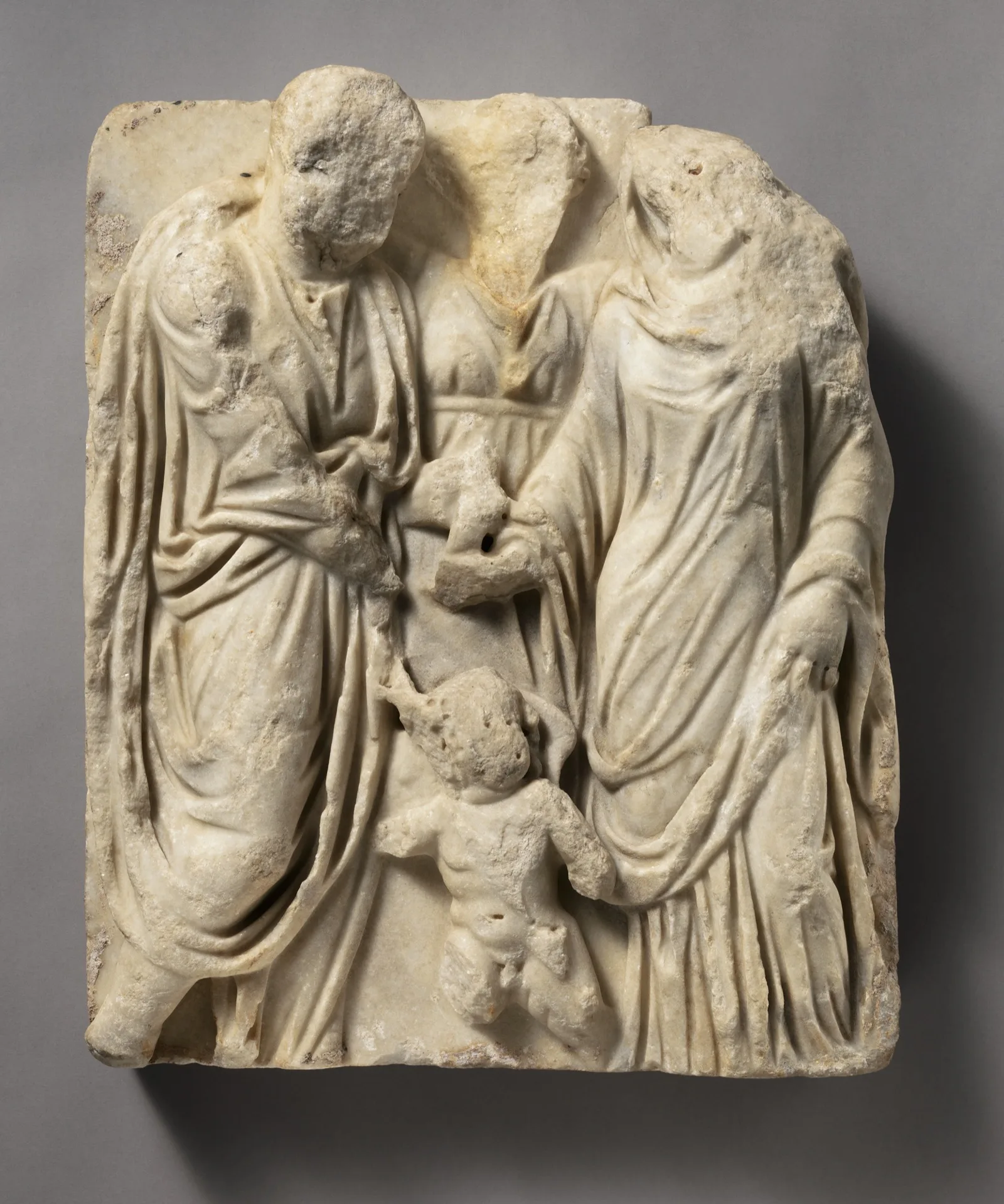
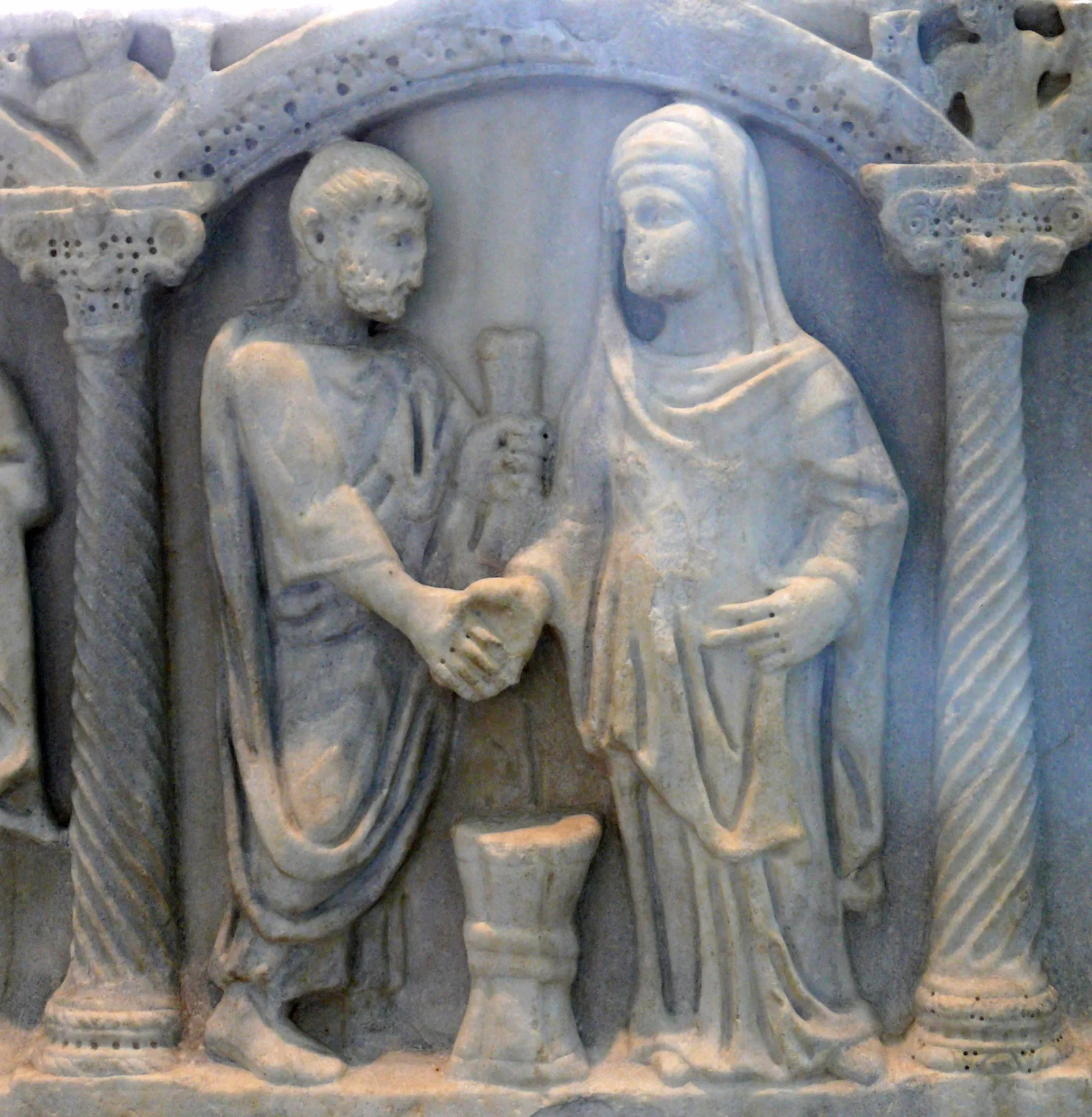

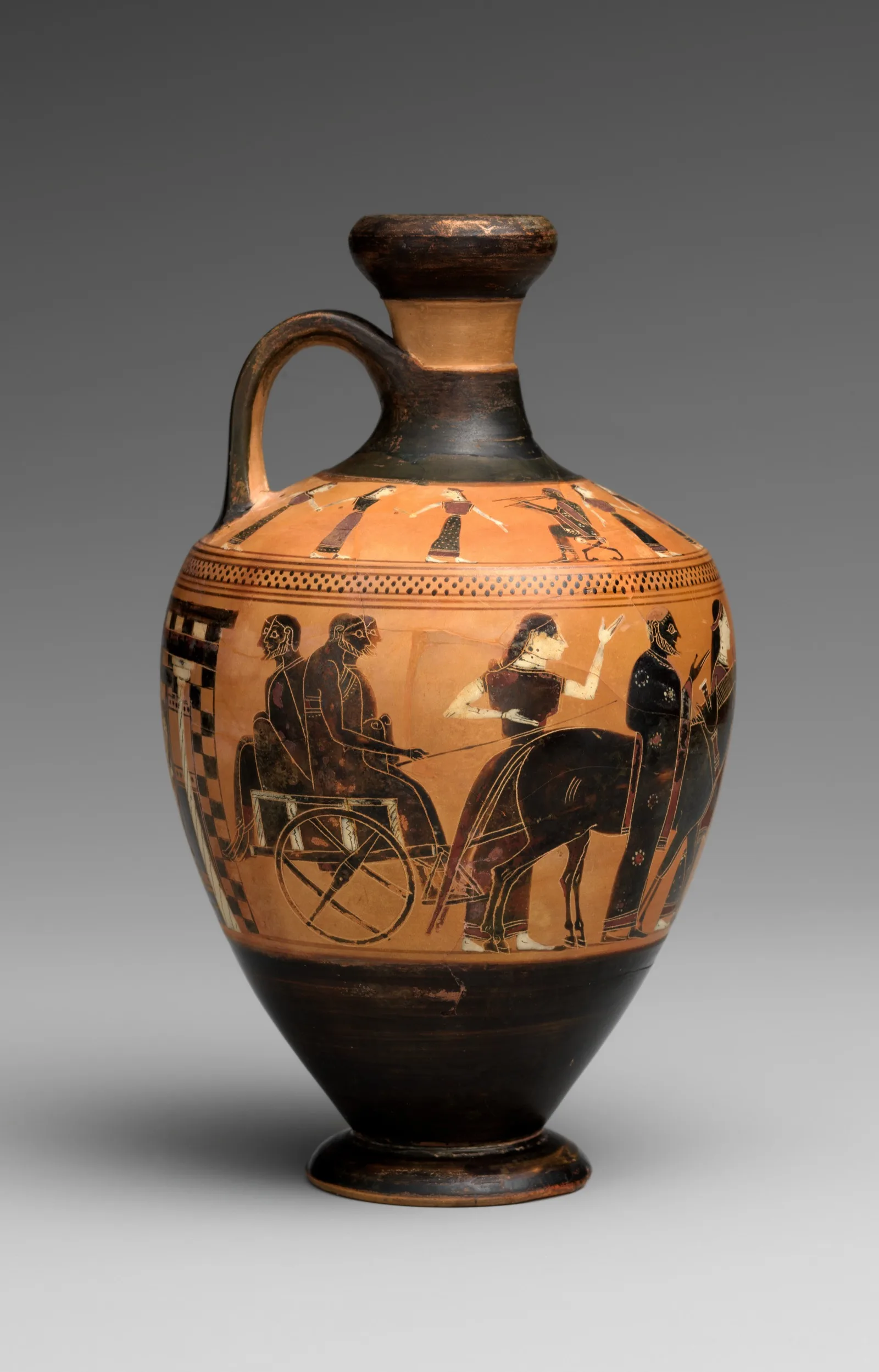
Three ways to marry
Roman law "recognized three forms of marriage," the Britannica summarizes. Confarreatio "was marked by a highly solemnized ceremony involving numerous witnesses and animal sacrifice" and "usually reserved for patrician families"; coemptio, "used by many plebeians, was effectively marriage by purchase"; and usus, "the most informal variety, was marriage simply by mutual consent and evidence of extended cohabitation."1 Confarreatio took its name from the cake of far, emmer wheat, the couple shared, with Jupiter's priest and the pontifex maximus presiding and ten witnesses present.2 The bride wore the flammeum, the veil whose color the ancient sources themselves argued about, yellow by Pliny's account.3 Catullus's wedding hymn has the torches raised and "the gleaming veil" approaching.3
The joined right hands
The Roman image of marriage was two right hands clasped, the dextrarum iunctio, carved on sarcophagi and rings across the empire.4 It never left. The English rite of 1549 has the minister "cause the man to take the woman by the right hande," and the 1662 Book of Common Prayer, still in use, has him "with his right hand to take the Woman by her right hand" and say: "I N. take thee N. to my wedded wife, to have and to hold from this day forward, for better for worse, for richer for poorer, in sickness and in health, to love and to cherish, till death us do part."56 Those words are older than the prayer book. The medieval Sarum rite has them in Middle English, "tyl deth us departe," and the bride's promise to be "bonoure and buxum in bed and at bord."7 The 1549 version reads "til death us departe," meaning separate; "do part" is a later smoothing.5
The first half of a medieval English wedding happened outside. The Sarum rite began "in the church porch," a practice "common to all Western Christendom," where the rings and the coins were blessed before the couple went in for Mass.8 Chaucer's Wife of Bath is the witness everybody quotes: "Housbondes at chirche dore I have had fyve."9
The threshold
Plutarch asks it straight: "Why do they not allow the bride to cross the threshold of her home herself, but those who are escorting her lift her over?"10 His first guess: "Is it because they carried off by force also the first Roman brides and bore them in in this manner, and the women did not enter of their own accord?"10 His second is about reluctance to lose her virginity; his third, that "the woman may not go forth of her own accord and abandon her home if she be not constrained, just as it was under constraint that she entered it."10 He adds a Boeotian parallel from his own country: "they burn the axle of the bridal carriage before the door, signifying that the bride must remain."10 In his life of Romulus he ties it to the Sabine women outright: the bride "shall not of herself cross the threshold into her new home, but be lifted up and carried in, because the Sabine women were carried in by force."11 The Roman wedding cry, he says, was "Talasius," as "Hymenaeus" was the Greek.11
None of his three guesses is about tripping. The story that a stumble on the sill was a bad omen has no ancient source; Catullus, the closest text, asks the bride to cross "with good omen" on her own "golden feet."3 The carry is a memory of an abduction myth, and the Romans knew it.
Why your mother cares
The threshold carry is the one Roman gesture that survived without its religion. Nobody in your family believes in the Sabine women; someone in your family will still expect a photo at the door. And the vow your grandmother took, if she took it in an Anglican or most Protestant churches, is the 1662 text, which is the Sarum text, which is a right hand in a right hand on a Roman coffin. When your mother says the old words are the old words, this is the one time she is exactly right.
Plutarch was already explaining the threshold to readers who had forgotten why. The custom outlived its story by nineteen centuries without a single picture of it.
Asked at the desk
Why is the bride carried over the threshold?
Plutarch, around AD 100, gave three explanations, the first being the abduction of the Sabine women; the "so she won’t trip" version has no ancient source.1011
What were the three kinds of Roman marriage?
Confarreatio (a patrician rite with a shared emmer cake and ten witnesses), coemptio (a symbolic purchase), and usus (a year of cohabitation).12
Where does "till death do us part" come from?
The medieval Sarum rite ("tyl deth us departe"), carried into the 1549 and 1662 Books of Common Prayer.57
Why were medieval weddings at the church door?
The Sarum rite began in the porch, where rings and coins were blessed, before the nuptial Mass inside; the practice was common across Western Christendom.8
The receipt
- Encyclopaedia Britannica, "marriage law." britannica.com
- Wikipedia, "Confarreatio," citing Karen K. Hersch, The Roman Wedding (2010). en.wikipedia.org
- Catullus, Carmina 61 (Latin and Burton translation), Perseus Digital Library, Tufts University; Wikipedia, "Flammeum," on the veil’s color. perseus.tufts.edu · en.wikipedia.org
- Wikipedia (German), "Dextrarum iunctio," citing Reinhard Stupperich, Boreas 6 (1983). de.wikipedia.org
- The Book of Common Prayer (1549), "Of Matrimony," Society of Archbishop Justus. justus.anglican.org
- Church of England, The Book of Common Prayer (1662), "The Form of Solemnization of Matrimony." churchofengland.org
- Wikipedia, "Wedding vow," quoting the Sarum rite from J. Wickham Legg (1915). en.wikipedia.org
- Catholic Encyclopedia (1910), "Ritual of Marriage." newadvent.org
- Geoffrey Chaucer, "The Wife of Bath’s Prologue," Harvard’s Geoffrey Chaucer Website. chaucer.fas.harvard.edu
- Plutarch, Roman Questions 29, Loeb Classical Library (1936), LacusCurtius, University of Chicago. penelope.uchicago.edu
- Plutarch, Life of Romulus 15, trans. Perrin (1914), Perseus Digital Library. perseus.tufts.edu
Shelved 2026-09-05 · back to the wall